
The deleterious effects of microgravity are undeniable: reduced bone mineral density, muscle atrophy, vascular remodeling, etc. These health issues may derive from both systemic factors, and from direct alterations to intracellular components and in the local microenvironment around cells. To understand the biological mechanisms at play, detailed studies have been performed in spaceflight. However, because experiments on the International Space Station (ISS) can be prohibitively expensive, clinostats are an alternative ground-based analogue for cellular studies. Clinostats “randomize” the orientation of gravity with respect to the cell fixed-frame, thereby simulating microgravity by eliminating a preferential gravity direction.
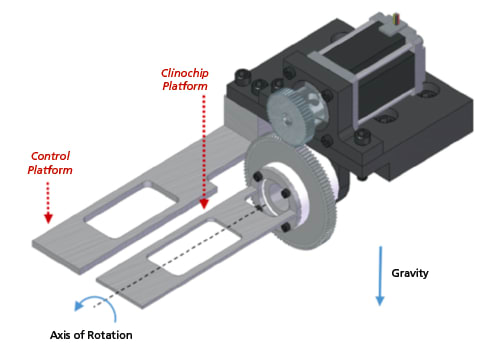
With the recently developed clinochip system, clinorotation time-lapse micros - copy is possible and enables time-lapse imaging of cells in simulated microgravity. The clinochip is a lab-on-chip configuration that accommodates elastic substrates, complex microfluidics, and same-cell tracking requirements to enable a wide range of science investigations. Cells can be cultured in monolayer, in suspension, or in 3D constructs. In all, the compact system provides not only traditional endpoint outcomes, but also dynamic cellular processes, while offering the ability to precisely modulate the microenvironment and fluid flow around cells. (See Figure 1)
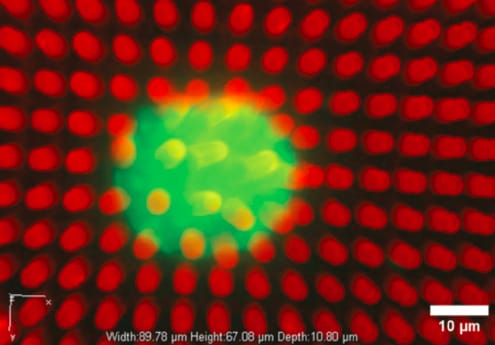
Results derived from this force-sensing clinochip innovation are important for determining possible gravisensing mechanisms in cells. Eventually, therapeutic countermeasures could potentially be developed. Other complex cell assays are also possible by adapting the current configuration with other labon-chip devices. (See Figure 2)
Finally, the clinochip system could potentially be commercialized and an entity may offer several different system configurations targeting various science investigations (i.e., microgravity research vs. tissue engineering), and provide different interface adapters for peripheral devices (e.g., microscope, pump, control electronics, etc.).
This work was performed by Alvin Yew of NASA Goddard Space Flight Center; and Javier Atencia, Adam Hsieh, and Carlos Luna of the University of Maryland, College Park. GSC-16834-1
This Brief includes a Technical Support Package (TSP).
Live-Cell Microscopy and Traction Force Measurements with Simulated Microgravity “Clinochip”
(reference GSC-16834-1) is currently available for download from the TSP library.
Don't have an account?
Overview
The document outlines the development and capabilities of a clinochip system designed for clinorotation time-lapse microscopy (CTM), which facilitates long-term, low-shear cell culture under simulated microgravity conditions. This innovation addresses significant limitations in current space biology research, particularly the challenges associated with using the International Space Station (ISS) for continuous monitoring of cell experiments. The ISS's accessibility issues and the constraints of conventional clinostats hinder real-time observation of dynamic cellular processes.
The CTM system is notable for its affordability and compact design, allowing it to be mounted directly onto a microscope stage without the need for large equipment. This setup enables researchers to conduct microgravity studies that not only focus on traditional endpoint outcomes but also on the time-evolution of cellular alterations. The clinochip can accommodate various lab-on-chip devices, including microcavities for cell culture and chemical gradient generators, and supports cells in monolayer, suspension, and 3D constructs.
A key feature of the CTM system is its magnetically clamped rotary joint, which is smaller than existing commercial devices for fluid transfer between stationary and rotating systems. This rotary joint allows for precise fluid exchange and continuous media circulation, which is essential for maintaining cell cultures over extended periods. The system employs a stepper motor for controlled rotation, enabling simultaneous imaging of cells under microgravity simulation and static control.
The document highlights the advantages of the CTM system over traditional clinostats, including the elimination of complicated optimization procedures required to balance centrifugal and gravitational forces. This innovation allows for real-time assays, addressing a critical need in microgravity research. The potential commercial applications of the rotary joint technology extend beyond space biology, with implications for various industries, including oil drilling, cooling systems, and medical devices.
In summary, the clinochip system represents a significant advancement in the field of space biology, providing researchers with a powerful tool to investigate the effects of microgravity on cellular behavior. Its unique features and capabilities position it as a valuable asset for both scientific research and potential commercial applications.