
The National Institute of Standards and Technology (NIST) has developed prototype calibration tools for an experimental medical imaging technique that offers new advantages in diagnosing and monitoring of certain cancers and possibly other medical conditions.
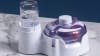
NIST designed, constructed and tested two prototype phantoms for calibrating ultralow-field (ULF) magnetic resonance imaging (MRI) systems. Phantoms are widely used tools for quality control in medical imaging. They are generally objects with simple shapes but very well-defined responses to a specific type of imaging scanner. As their name implies, phantoms are stand-ins for the body, and are used to help optimize MRI machines to deliver the best possible medical images for a given type of tissue.
The NIST prototypes are the first standard calibration tools for ULF-MRI, offering a quantitative means to assess performance, validate the technique, and directly compare different experimental and clinical MRI scanners.
ULF-MRI also offers practical advantages: The instruments are simpler in design, lighter in weight and less expensive than regular MRI scanners. That's because ULF-MRI operates at much lower magnetic field strengths, measured in microteslas, thousands of times lower than conventional MRI, which operates at up to 3 teslas and requires huge magnets. The low magnetic field strength means ULF-MRI needs the most sensitive magnetometers available: SQUIDs (superconducting quantum interference devices). This is convenient because it makes ULF-MRI suitable for combining with other SQUID-based imaging techniques such as magnetoencephalography.