Application Briefs: Aerospace
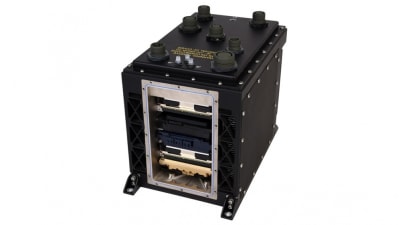
RASOR™, L3Harris’ new Modular Open System Approach (MOSA) solution, delivers next-generation JADC2-enabling capability to the U.S. military.
Videos: Sensors/Data Acquisition
Wearable technology is becoming more ubiquitous by the day.
Videos: Materials
Fei Peng, associate professor of materials science and engineering at Clemson, is leading research to develop a new type of coating for the blades of turbines powered by hydrogen — a big...
Videos: Materials
Bioscientists at Rice University have introduced centimeter-scale, slime-like colonies of engineered bacteria that self-assemble from the bottom up. It can be programmed to soak up...
Briefs: Data Acquisition
A new study suggests mobile data collected while traveling over bridges could help evaluate their integrity.
News: Manufacturing & Prototyping
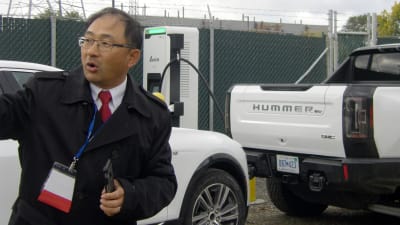
The ability to charge electric vehicles at a very fast rate is a key to electrifying mobility across the U.S. It’s a focus of the U.S. Dept. of Energy’s Extreme Fast Charger project,...
NASA Spinoff: Aerospace
An all-in-one, single-board computer module can withstand 900ºF conditions without a cooling system thanks to Glenn Research Center expertise in extreme-temperature technology.
NASA Spinoff: Unmanned Systems
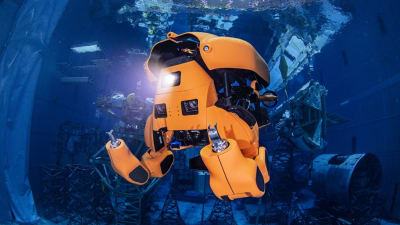
Aquanaut, built on lessons from NASA’s robot astronaut, will cut costs for ocean industries.
NASA Spinoff: Software
Physics-based computer modeling software makes it possible to build, examine, and test virtual 3D-printed metal parts that meet the exacting standards of NASA’s Jet Propulsion Laboratory.
NASA Spinoff: Electronics & Computers
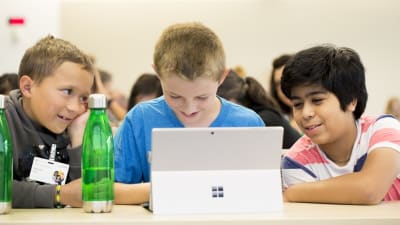
To create programming teaching materials, Microsoft Corp. of Redmond, Washington, collaborated with the Office of STEM Engagement at NASA Headquarters under a Space Act Agreement.
NASA Spinoff: Software
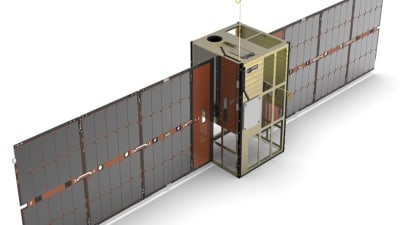
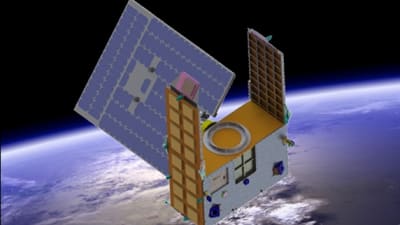
CubeSats start with a hardware bus that houses and enables payloads. NASA Tipping Point funding for test flights informed the development of the Trestles bus sold by Irvine, California-based Tyvak Nano-Satellite Systems Inc.
NASA Spinoff: Imaging
Traveling-wave tubes designed for NASA are being used not only for satellite systems but also ground applications.
NASA Spinoff: RF & Microwave Electronics
The Jet Propulsion Laboratory worked with the Department of Homeland Security to construct a prototype of a device that can detect people buried under several feet of material.
NASA Spinoff: Imaging
Commercial helicopters now use the video switcher developed by Van Nuys, California-based Eon Instrumentation Inc. to meet Langley Research Center specifications.
NASA Spinoff: Manned Systems
When NASA was looking for a low-cost solution to launch into orbit, Barber-Nichols of Arvada, Colorado, was subcontracted to build the turbopump for the Fastrac rocket engine at Marshall Space Flight Center.
NASA Spinoff: RF & Microwave Electronics
NASA plans to use solar electric propulsion to send astronauts to Mars, but the technology will require huge solar arrays that take up precious space in a rocket fairing.
NASA Spinoff: Transportation
To enable their private astronauts to live and work in orbit, Axiom Space of Houston used NASA facilities and people with NASA experience to train their crews of private astronauts that travel to the space station.
NASA Spinoff: Aerospace
Several engineers who worked on the experimental Morpheus lander at Johnson Space Center have applied that technical knowledge to building a commercial lunar lander at Intuitive Machines LLC in Houston.
NASA Spinoff: Design
During the early stages of the COVID-19 pandemic, engineers at the Jet Propulsion Laboratory designed a ventilator that could be produced quickly and cheaply.
NASA Spinoff: Green Design & Manufacturing
In order to make vast amounts of satellite data accessible to anyone, Goddard Space Flight Center and Ames Research Center moved data into the cloud, developed search algorithms, and provided open-source code to model climate impacts.
NASA Spinoff: Imaging
For half a century, NASA-built Landsat satellites have been recording Earth’s surface. That data yields valuable information for farmers, water managers, food manufacturers, and countless others.
NASA Spinoff: Aerospace
A collaboration resulted in a new program to manage airport traffic on the ground – the Integrated Arrival, Departure, and Surface system – leading to shorter wait times for passengers, a drop in air pollution, and significant cost savings.
NASA Spinoff: RF & Microwave Electronics
The proliferation of navigation satellites in Earth orbit – and a few companies’ specially outfitted small satellites – will enable more accurate weather readings on Earth.
NASA Spinoff: Aerospace
Ensuring safety for astronauts on the world’s first reusable spacecraft required NASA’s space shuttle engineers to take novel approaches when calculating the structural dangers of small fractures.
NASA Spinoff: Manufacturing & Prototyping
Using a temperature-controlling material developed in part under an SBIR from Johnson Space Center for spacesuit gloves, Fifty One of London is making clothes to alleviate the symptoms of menopause.
NASA Spinoff: Aerospace
A non-toxic material proposed as an alternative for balancing temperature extremes ultimately led Columbia, Missouri-based ThermAvant International LLC to develop a thermal mug to transform scalding-hot coffee into a drinkable beverage in seconds and keep it warm for hours.
NASA Spinoff: Manufacturing & Prototyping
A microbe found in Yellowstone National Park during NASA-funded research is now the basis of a fungal protein from which Chicago-based Nature’s Fynd produces meat-alternative breakfast patties and non-dairy cream cheese.
NASA Spinoff: Green Design & Manufacturing
Kennedy Space Center spent decades developing indoor farming techniques to support a closed-loop life-support system for space travel. Eden Grow Systems Inc. of Houston used the published results to build automated, energy-efficient, aeroponic grow towers.
NASA Spinoff: Energy
To determine how well a suspended solar panel system would hold up to potentially destructive oscillations caused by wind, Skysun LLC in Cleveland, Ohio sought the help of NASA employees to verify its product would be safe from dangerous resonance.














 INSIDER: Medical
 Features: Medical
 Features: Materials
 From the Editor: Medical
 INSIDER: Medical
 Features: AR/AI

 Podcasts: Medical
 Podcasts: Medical
 Podcasts: Design
 On-Demand Webinars: Manufacturing & Prototyping
 Podcasts: AR/AI
 Podcasts: Green Design & Manufacturing
