The Industrial Internet of Things — sharing, collecting, and analyzing information across a complete manufacturing enterprise — can significantly enhance the bottom line. Not only in monetary terms but also in the quality and reliability of the products and the ability to deliver them on time.
In people with epilepsy, seizure-alert dogs can smell small changes in body chemistry and warn of an impending seizure an hour or more before it occurs. Inspired by this feat of nature, a team of researchers has developed a way to replicate that ability with technology.
Call it a “technology-meets-the-moment” place in the transportation sector’s innovation timeline. After decades of concentrated development work, GM’s fuel-cell R&D...
Praneeth Namburi is a research scientist at the MIT.nano Immersion Lab. One project that bridges the physical and digital worlds uses VR simulations to train people to fabricate computer chips and semiconductors.
See the new products, including Thine Electronics' serial transceiver, EBE Elektro-Bau-Elemente GmbH's level sensor, Melexis' ToF sensor, IQE's microLED display, and more.
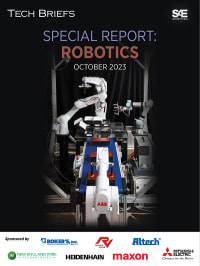
Read about the latest advances in robots for space exploration, healthcare, manufacturing, and more in this compendium of recent articles from the editors of Tech Briefs, Medical Design Briefs, and Aerospace &...
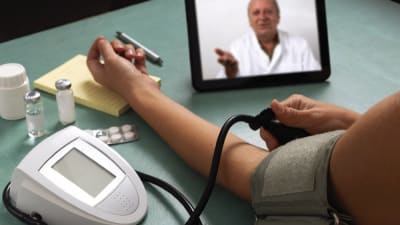
Devices to remotely monitor patients’ health have been around for more than 20 years, but their use is rapidly expanding now. As networking technologies such as LoRaWAN are maturing, and artificial intelligence is being embedded in “smart” sensors, the medical device industry is motivated to take advantage.
Autonomous mobile robots are one of the most exciting technologies in the robotics and automation sector. How important is the integration between the hardware and software? How will AI influence the next generation of AMRs? Tech Briefs posed these questions to five industry experts to garner their views on the current status and future outlook for AMRs.
The future of transportation is shifting toward hybrid and electric vehicles (xEV), making the development of powertrain systems more intricate. Meeting stringent development timelines adds to the challenges faced by the industry.
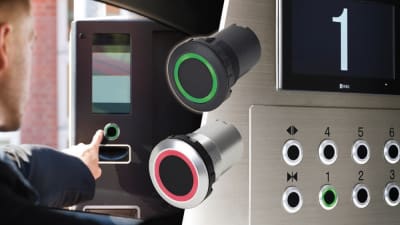
Touchless switches are an ideal solution for industries such as food, beverage, pharmaceuticals, medical, and chemicals where sanitary design is important. They are also useful for protecting the well-being of users in everyday commercial applications.
A Northwestern University research team has developed a revolutionary transistor that is expected be ideal for lightweight, flexible, high-performance bioelectronics. The electrochemical transistor is compatible with blood and water and can amplify important signals.
A new thermoelectric cooler developed by Penn State scientists greatly improves the cooling power and efficiency compared to current commercial thermoelectric units and may help control heat in future high-power electronics, the researchers said.
Imagine a thin, digital display so flexible that you can wrap it around your wrist, fold it in any direction, or even curve it over your car’s steering wheel. Well, imagine no more — researchers at the Pritzker School of Molecular Engineering at the University of Chicago have designed such a material.
NASA Ames has developed a new state-of-the-art method for measuring fluctuating aerodynamic-induced pressures on wind tunnel models using unsteady Pressure Sensitive Paint (uPSP).
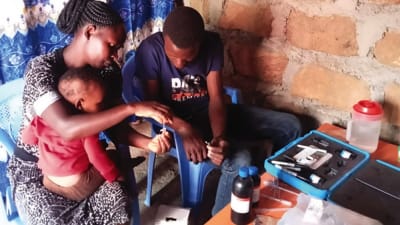
Researchers from Northwestern University have collaborated on the implementation of an accurate, low-cost, and easy-to-use test for detecting toxic levels of fluoride in water. The new biosensor device has been field tested in Kenya.
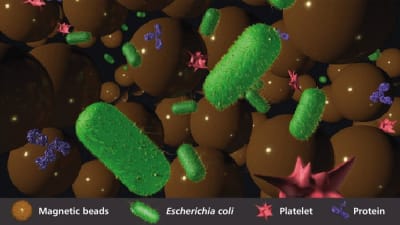
Researchers were able to successfully isolate bacteria from various fluids with a microparticle-based matrix filter. The filter trapped particles in small voids in the device, providing a larger concentration of bacteria for analysis.
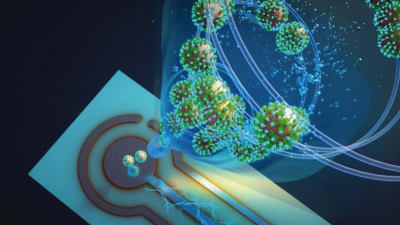
By combining recent advances in aerosol sampling technology and an ultrasensitive biosensing technique, researchers at Washington University in St. Louis have created a real-time monitor that can detect any of the SARS-CoV-2 virus variants in a room in about five minutes.
NASA researchers have developed a technology that yields 3D tissue-like assemblies of human broncho-epithelial cells for in vitro research on infection of humans by respiratory viruses.
In Penn’s Clean Energy Conversions Lab, researchers are repurposing waste from industrial mines, storing carbon pulled from the atmosphere into newly formed rock. The team sees great environmental potential in mine tailings.
In 1978, NASA scientist Donald J. Kessler theorized that an increasing amount of space pollution would lead to more collisions between objects in orbit, and thus more debris — the Kessler Syndrome. Multiple teams of researchers are working on solutions.
Scientists at UC Riverside and the University of Delaware have found a way to bypass the need for biological photosynthesis altogether and create food independent of sunlight by using artificial photosynthesis.
Innovators at NASA Johnson Space Center in collaboration with IRPI, LLC, have developed a compact inline filter that uses a multi-phase flow method to separate liquid from an incoming air charge. The filter also traps particulate matter and does so without significantly impinging upon flow velocity.
A team has introduced a new method for taking high-res images of fast-moving and rotating objects in space, such as satellites or debris in low-Earth orbit.
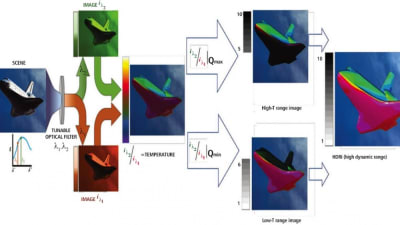
Innovators at NASA Langley Research Center have developed a multi-spectral imaging pyrometer utilizing tunable optics. The system uses a conventional infrared imaging camera as the basis.
Understanding power system components and how to connect them correctly is critical to meeting regulatory requirements and designing successful electrical products for worldwide markets. Interpower’s Ralph Bright defines these requirements and explains how to know which cord to select for your application.
Inside Story: Trends in Packaging and Sterilization
Eurofins Medical Device Testing (MDT) provides a full scope of testing services. In this interview, Eurofins’ experts, Sunny Modi, PhD, Director of Package Testing; and Elizabeth Sydnor, Director of Microbiology; answer common questions on medical device packaging and sterilization.














 INSIDER: Medical
 Features: Medical
 Features: Materials
 From the Editor: Medical
 INSIDER: Medical
 Features: AR/AI

 Podcasts: Medical
 Podcasts: Medical
 Podcasts: Design
 On-Demand Webinars: Manufacturing & Prototyping
 Podcasts: AR/AI
 Podcasts: Green Design & Manufacturing
