Briefs: Software
The Automated Real-Time Spacecraft Navigation (ARTSN) system is a prototype of a class of software systems for automated navigation and monitoring of spacecraft from stations on the Earth. The system processes radio metric tracking data (principally, range and Doppler measurements) in real time to...
Briefs: Materials
Metal-supported catalyst beds with improved thermal and flow characteristics for promoting endothermic chemical reactions are undergoing development. In the proposed original application,...
Briefs: Materials
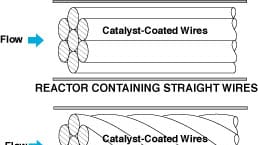
In catalytic flow-through chemical reactors being explored for space vehicle applications, the catalysts would be supported on the surfaces of wires, instead of on particles, as are typically used in...
Briefs: Materials
In an extension of the concept reported in the preceding article, catalytic flow-through chemical reactors of a proposed type would contain catalyst-coated microtubes, possibly in combination with...
Briefs: Mechanical & Fluid Systems
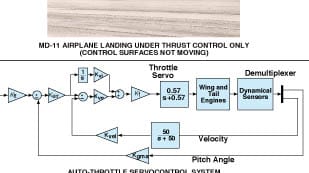
Extensive redundancy is designed into aircraft flight-control systems to ensure a low probability of failure. During recent years, however, major failures of flight-control systems have...
Briefs: Manufacturing & Prototyping
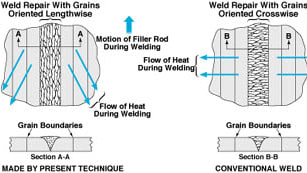
An arc-welding technique for repair of a directionally solidified (DS) nickel-base superalloy article (e.g., a turbine blade or vane) has been devised. The technique equally is...
Briefs: Physical Sciences
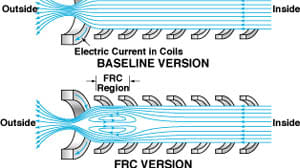
A field-reversed configuration (FRC) has been proposed for a magnetic mirror — a solenoidal electromagnet configured and operated in such a way as to effect at least partial...
Briefs: Physical Sciences
Version 5.0 of the Integrated Modeling of Optical Systems (IMOS) software has been released. A previous version was described in "Software for Multidisciplinary Analysis of Optical Systems" (NPO-20536), NASA Tech Briefs, Vol. 24, No. 11 (November 2000), page 36. In both versions, IMOS is...
Briefs: Aerospace
The NASA Dryden DC-8 Airborne Science Laboratory (see Figure 1) performs research around the globe, recently in support of the SAGE III Ozone Loss and Validation Experiment (SOLVE). This...
Briefs: Information Technology
A method to predict the onset of a limit cycle for an aeroelastic testbed has been developed. The prediction is based on wavelet processing of measurement data that have been recorded under various...
Briefs: Photonics/Optics
Infrared (IR) sensors of a proposed type, and integrated-circuit imaging devices containing planar arrays of such sensors, would be based on a combination of (1)...
Briefs: Photonics/Optics
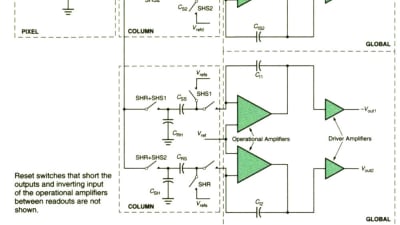
A proposed complementary metal oxide/semiconductor (CMOS) integrated-circuit imaging device of the active-pixel sensor (APS) type is capable of simultaneously generating the pixel-by-pixel sum...
Briefs: Electronics & Computers
The Telecom Forecaster Predictor (TFP) is a multi-mission computer program for analyzing deep space telecommunication links. Analysts use the TFP for link planning, performance prediction, and post-pass trending analysis. For each mission, multiple users access a controlled set of TFP...
Briefs: Photonics/Optics
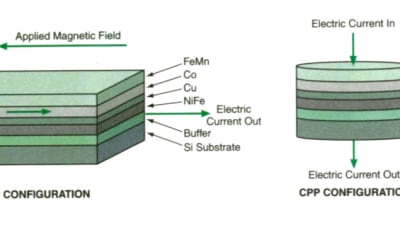
Integrated-circuit imaging devices of a proposed type would contain planar arrays of microscopic sensors that would exploit giant magnetoresistance (GMR). Each GMR sensor in such a device...
Briefs: Manufacturing & Prototyping
A process for making precise, high-quality curved or flat mirror surfaces on bare aluminum substrates has been devised. The process consists of (1) diamond turning to establish the...
Briefs: Motion Control
In a proposed technique for fabrication of microelectromechanical devices, thin films of fullerenes would be used as temporary packaging to protect and position delicate components....
Briefs: Materials
David Spencer (MIT) developed semi-solid material processing through an accidental observation he made while dealing with the processing of metals in their mushy state. The semi-solid material process basically consists of two stages: pre-processing and processing. During pre-processing, the...
Briefs: Motion Control
A data system generates information on the position and orientation of a pointing instrument (e.g., a telescope or a laser) that could be mounted on a moving platform (e.g., an aircraft) and...
Briefs: Photonics/Optics
A method of processing phase measurements in a large, unequal-arm laser Michelson interferometer makes it possible to measure phase effects much smaller than the laser phase noise....
Briefs: Robotics, Automation & Control
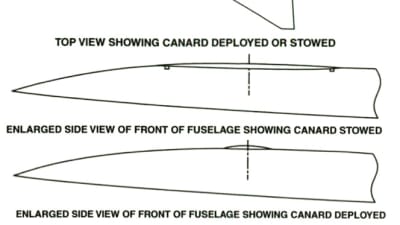
An improved secondary wing system of the canard type has been invented to improve performance and increase efficiency of airplanes capable of flight at supersonic and high subsonic speeds. Canards, including small...
Briefs: Photonics/Optics
An improved visual display system for a helmet produces two- and three-dimensional images by use of the limited domain of spatial light modulation (SLM) values. One especially notable improvement incorporated into the design of this system is a simplification in the design of dynamic...
Briefs: Photonics/Optics
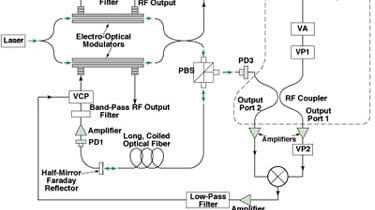
Optoelectronic oscillators (OEOs) that incorporate carrier-suppression subsystems for reduction of close-to-carrier phase noise are undergoing development. The carrier-suppression...
Briefs: Photonics/Optics
A control scheme for nulling interferometry has been devised to make it possible to stabilize interferometric optical-path-length differences to within approximately a nanometer. This...
Briefs: Electronics & Computers
The Autogenic Clinical/Lab System (ACLS) is a personal-computer-based instrumentation system for physiological training. This system can be used to implement a program of multiparameter...
Briefs: Electronics & Computers
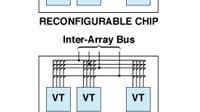
Very-large-scale integrated (VLSI) circuits containing electronically reconfigurable arrays of transistors have been proposed as means to implement a forthcoming generation of a...
Briefs: Electronics & Computers
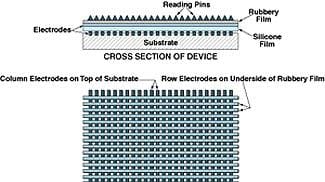
A proposed active tactile display device would present textual and graphical information to a blind person. The concept of this device is a byproduct of recent research on the use of...
Briefs: Information Technology
The VM Automated System computer program was developed to satisfy a need for efficient management of operations in a large client/server computer network that includes multiple mainframe computers and multiple local-area subnetworks. Functions performed by the program include the following:
Briefs: Electronics & Computers
A system that includes sensors and computers that communicate via an intranet enables both real-time monitoring and subsequent analysis of acoustic, overpressure, and thermal aspects of a spacecraft-launch environment and the structural response (vibration and strain) to that...
Briefs: Test & Measurement
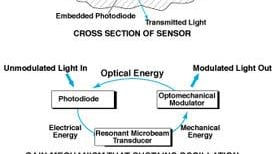
Miniature fiber-optic-coupled sensors based on optically excited, self-resonant microbeams are being developed for measuring stresses and strains within muscle fascicles and tendons....










 INSIDER: Medical
 Features: Medical
 Features: Materials
 From the Editor: Medical
 INSIDER: Medical
 Features: AR/AI

 Podcasts: Medical
 Podcasts: Medical
 Podcasts: Design
 On-Demand Webinars: Manufacturing & Prototyping
 Podcasts: AR/AI
 Podcasts: Green Design & Manufacturing
