Articles: Defense
What are the challenges for women in aerospace and what more can be done to increase the number of women in the STEM workforce? Tech Briefs interviewed Audrey Schaffer, Vice President of Strategy and Policy, Slingshot Aerospace, who has made significant strides in the aerospace industry.
Articles: Physical Sciences
Significant progress in industry, especially in manufacturing and material science, is expected to be driven by quantum computing. Using sophisticated simulations and optimization techniques, the technology promises to accelerate the discovery of new substances and improve production procedures.
Briefs: Information Technology
IO-Link is a digital advancement combining the essential electrical and electronic characteristics of other connectivity methods. The resulting devices and architecture are enabling designers to create more intelligent equipment, streamline installation, and reduce overall costs.
Briefs: Physical Sciences
The nanoscale electronic parts in devices like smartphones are solid, static objects that once designed and built cannot transform into anything else. But a team from University of California Irvine has reported the discovery of nanoscale devices that can transform into many different shapes and sizes even though they exist in solid states.
Briefs: Robotics, Automation & Control
This advancement, one of the first of its kind, enables a useful new capability for a variety of applications, including improved prostheses, haptics for new modalities in augmented reality (AR), and thermally modulated therapeutics for applications such as pain management. The technology also has a variety of potential industrial and research applications.
Briefs: Materials
The miniscule wires — the size of transistors on silicon chips or one thousandth of the breadth of the finest human hair — are made completely of natural amino acids and heme molecules, found in proteins such as hemoglobin, which transports oxygen in red blood cells.
Briefs: Materials
Engineers at the University of California San Diego have developed electronic “stickers” that measure the force exerted by one object upon another. The force stickers are wireless, run without batteries and fit in tight spaces. That makes them versatile for a wide range of applications.
Briefs: Electronics & Computers
A research team has successfully overcome the limitations of soft strain sensors by integrating computer vision technology into optical sensors. The team developed a sensor technology known as computer vision-based optical strain (CVOS) during its study. Unlike conventional sensors reliant on electrical signals, CVOS sensors employ computer vision and optical sensors to analyze microscale optical patterns, extracting data regarding changes.
Briefs: Electronics & Computers
Monitoring the success of surgery on blood vessels is challenging, as the first sign of trouble often comes too late. A new device could make it easier for doctors to monitor the success of blood vessel surgery.
Briefs: Wearables
Researchers at The Ohio State University have fabricated the first wearable sensor designed to detect and monitor muscle atrophy. This new study published in the journal IEEE Transactions on Biomedical Engineering suggests that an electromagnetic sensor made out of conductive “e-threads” could be used as an alternative to frequent monitoring using MRI.
Briefs: Manned Systems
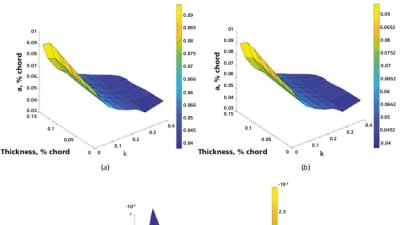
NASA’s Ames Research Center has developed a novel closed-form solution to model wing flutter aerodynamics for any aircraft wing (within a certain thickness regime and without camber). This closed-form solution can be readily extended to wing sections with camber.
Briefs: Aerospace
Northrop Grumman Corporation is developing AN/APG-85, an advanced Active Electronically Scanned Array (AESA) radar for the F-35 Lightning II.
Briefs: Power
Boom Supersonic, the company building supersonic planes, is developing Symphony, a new propulsion system designed and optimized for its Overture supersonic airliner.
Briefs: Aerospace
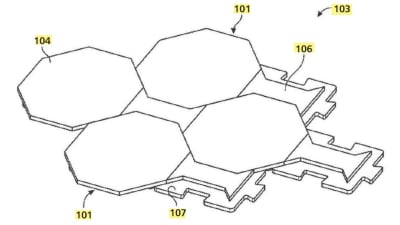
Engineers at NASA’s Kennedy Space Center and Sidus Space developed a novel interlocking paver system enabling the robotic construction of high-stability vertical takeoff and landing pads.
Briefs: Robotics, Automation & Control
Meet Air-Guardian: A system developed by researchers at the MIT Computer Science and Artificial Intelligence Laboratory (CSAIL). As modern pilots grapple with an onslaught of information from multiple monitors, especially during critical moments, Air-Guardian acts as a proactive co-pilot; a partnership between human and machine, rooted in understanding attention.
Briefs: Materials
A technique enables manufacturing of minuscule robots by interlocking multiple materials in a complex way.
Briefs: Manufacturing & Prototyping
A first-of-its-kind robotic glove is lending a “hand” and providing hope to piano players who have suffered a disabling stroke. Developed by researchers from Florida Atlantic University’s College of Engineering and Computer Science, the soft robotic hand exoskeleton uses artificial intelligence to improve hand dexterity.
Briefs: Aerospace
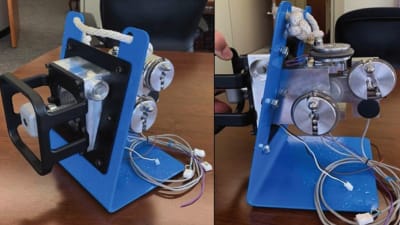
Innovators at NASA’s Johnson Space Center have designed a circumferential scissor spring mechanism, that when incorporated into a hand controller, improves the restorative force to a control stick’s neutral position. The design also provides for operation on a more linear portion of the spring’s force deflection curve, yielding better feedback to the user.
Briefs: Mechanical & Fluid Systems
Intrigued to see if many limbs could be helpful for locomotion in this world, a team at the Georgia Institute of Technology is using a centipede's style of movement to its advantage. They developed a new theory of multilegged locomotion and created many-legged robotic models.
Briefs: Data Acquisition
MIT researchers developed a machine-learning technique called Diffusion-CCSP. Diffusion models learn to generate new data samples that resemble samples in a training dataset by iteratively refining their output.
Briefs: Software
Inventors at the NASA Langley Research Center have developed a novel method to model and ingest point-wise process data to evaluate an additive manufacturing build and its file for issues by highlighting potential anomalies or other areas where the build may have issues with fusion of the material.
Briefs: Electronics & Computers
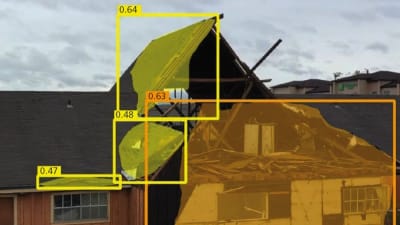
By using artificial intelligence, researchers are developing a system that can automatically identify buildings after disasters and make an initial determination of whether they are damaged and how serious that damage might be.
Briefs: Electronics & Computers
Researchers from MIT, the MIT-IBM Watson AI Lab, and elsewhere have developed a technique that enables deep-learning models to efficiently adapt to new sensor data directly on an edge device. Their on-device training method, Pock-Engine, determines which parts of a huge machine-learning model need to be updated to improve accuracy, and only stores and computes with those specific pieces.
Products: Photonics/Optics
See what's new on the market, including igus' two- and four-hole fixed flange bearings; FixtureBuilder 3D fixture-modelling software from Renishaw; XENON Corporation's X-1100/2x Pulsed Light Research System; Rad Source NDT's NDT 1000 X-ray Inspection System; and more.
Products: Electronics & Computers
See the Product of the Month: Bosch Sensortec's two new MEMS accelerometers, the BMA530 and BMA580. Read on to learn more.
Products: Internet of Things
See the product of the month: 2Pi Optics' high-resolution fisheye sensor based on optical metalens technology.
Products: Design
See the products of the year: The Talaria TWO Module Ultra-Low Power Wi-Fi optimized solution for cloud-connected IP video IoT devices by InnoPhase IoT; Hexagon's Elements, simulation software to better understand the increasingly complex behavior of systems in modern products; and Nexa3D's highest throughput additive production system, the QLS 820.












 INSIDER: Medical
 Features: Medical
 Features: Materials
 From the Editor: Medical
 INSIDER: Medical
 Features: AR/AI

 Podcasts: Medical
 Podcasts: Medical
 Podcasts: Design
 On-Demand Webinars: Manufacturing & Prototyping
 Podcasts: AR/AI
 Podcasts: Green Design & Manufacturing
