Briefs: Electronics & Computers
An all-solid-state replacement for high-frequency Gunn diode oscillators (GDOs) has been proposed for use in NASA’s millimeter- and submillimeter-wave sensing instruments. Highly developed microwave oscillators are used to achieve a low-noise and highly stable reference signal in the 10–40-GHz band....
Briefs: Electronics & Computers
Binary communication through long cables, opto-isolators, isolating transformers, or repeaters can become distorted in characteristic ways. The usual solution is to slow the communication rate, change to a different method, or improve the communication media. It would help if the characteristic distortions could be...
Briefs: Electronics & Computers
Current display technology has relied on flat, 2D screens that cannot truly convey the third dimension of visual information: depth. In contrast to conventional visualization that is primarily based on 2D flat screens, the volumetric 3D display possesses a true 3D display volume, and places physically...
Briefs: Electronics & Computers
This work considers cost-sensitive feature acquisition that attempts to classify a candidate datapoint from incomplete information. In this task, an agent acquires features of the datapoint using one or more costly diagnostic tests, and eventually ascribes a classification label. A cost function...
Briefs: Manufacturing & Prototyping
Carbon nanotube (CNT)-based sensors for structural health monitoring (SHM) can be embedded in structures of all geometries to monitor conditions both inside and at the surface of the structure to continuously sense changes. These CNTs can be manipulated into specific orientations to create...
Briefs: Manufacturing & Prototyping
A recent collaboration between the Whitesides Group at Harvard University and CSM Instruments has culminated in an important advance in lithography of different...
Briefs: Manufacturing & Prototyping
The design allows for the low-stress mounting of fragile objects, like thin walled glass, by using particular ways of compensating, isolating, or releasing the coefficient of thermal expansion (CTE) differences between the mounted object and the mount itself....
Briefs: Mechanical & Fluid Systems
Vibration in turbomachinery can cause blade failures and leads to the use of heavier, thicker blades that result in lower aerodynamic efficiency and increased noise. Metal and/or composite fatigue in the blades of jet engines has resulted in blade destruction and loss of lives. Techniques...
Briefs: Mechanical & Fluid Systems
A drive mechanism enables a socket-type wrench to rotate a shaft and prevents accidental rotation of the shaft when the wrench is not coupled to the shaft. In the original intended application, the shaft would be part of an attachment mechanism on a spacecraft, and the purpose to be served by...
Briefs: Mechanical & Fluid Systems
The Starr Soft Support isolation system incorporates an automatically reconfigurable aircraft jack into NASA’s existing 1-Hertz isolators. This enables an aircraft to float in mid-air without the need for a critical lift during ground vibration testing (GVT),...
Briefs: Mechanical & Fluid Systems
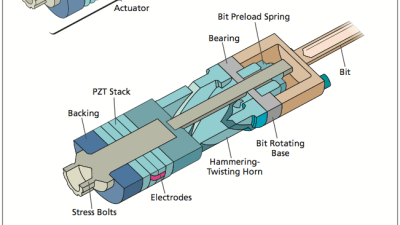
This innovation comprises a compact drill that uses low-axial preload, via vibrations, that fractures the rock under the bit kerf, and rotates the bit to remove the powdered cuttings while augmenting...
Briefs: Mechanical & Fluid Systems
Historically, cryogenic pumps used for propellant loading at Kennedy Space Center (KSC) and other NASA Centers have a bellows mechanical seal and oil bath ball bearings, both of which can be problematic and require high maintenance. Because of the extremely low temperatures, the mechanical seals are made of...
Briefs: Materials
Polyhydroxyamide (PHA) and polymethoxyamide (PMeOA) are fire-retardant (FR) thermoplastic polymers and have been found to be useful as an additive for imparting fire retardant properties to other compatible, thermoplastic polymers (including some elastomers). Examples of compatible flammable polymers include...
Briefs: Materials
A lift-gas cracker (LGC) is an apparatus that generates a low-molecular-weight gas (mostly hydrogen with smaller amounts of carbon monoxide and/or carbon dioxide) at low gauge pressure by methanol...
Briefs: Materials
A method for developing safe, easy-to-handle propellants has been developed based upon ionic liquids (ILs) or their eutectic mixtures. An IL is a binary combination of a typically organic cation and anion, which generally produces an ionic salt with a melting point below 100 °C. Many ILs have melting points near,...
Briefs: Materials
One of the last remaining technical hurdles with variable emittance devices or skins based on conducting polymer electrochromics is the high solar absorptance of their top surfaces. This high solar absorptance causes overheating of the skin when facing...
Briefs: Physical Sciences
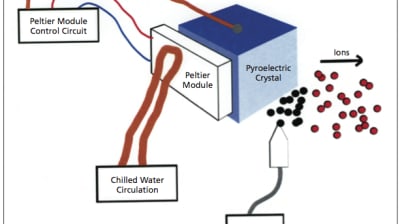
The detection of volatile vapors of unknown species in a complex field environment is required in many different applications. Mass spectroscopic techniques require subsystems including an...
Briefs: Physical Sciences
In precision control applications, thermometers have temperature-dependent electrical resistance with germanium or other semiconductor material thermistors, diodes, metal film and wire, or carbon film resistors. Because resistance readout requires...
Briefs: Physical Sciences
A new design for a broadband detector of gravitational radiation relies on two atom interferometers separated by a distance L. In this scheme, only one arm and one laser are used for operating the two atom interferometers. The innovation here involves the fact that the atoms in the...
Briefs: Physical Sciences
A titanium-alloy mirror-holding fixture called a strong back allows the temporary and permanent bonding of a 50° D263 glass x-ray mirror (IXO here stands for International X-ray Observatory). The strong back is used to hold and position a mirror segment so that mounting tabs may be bonded to the...
Briefs: Information Technology
A solution was developed that matches visible/IR imagery aboard a balloon in Saturn’s moon Titan’s atmosphere to SAR (synthetic aperture radar) and visible/IR data acquired from orbit. A balloon in Titan’s atmosphere must be able to localize itself autonomously...
Briefs: Information Technology
It is noted that the phenomenon of entanglement is not a prerogative of quantum systems, but also occurs in other, non-classical systems such as quantum-classical hybrids, and covers the concept of entanglement as a special type of global constraint imposed upon a broad class of dynamical systems....
Briefs: Information Technology
Because of their small size, high maneuverability, and easy deployment, micro aerial vehicles (MAVs) are used for a wide variety of both civilian and military missions. One of their current drawbacks is the vast array of sensors
(such as GPS, altimeter, radar, and the like) required to make a landing. Due to the...
Briefs: Information Technology
Based upon quantum-inspired entanglement in quantum-classical hybrids, a simple algorithm for instantaneous transmissions of non-intentional messages (chosen at random) to remote distances is proposed. The idea is to implement instantaneous transmission of conditional information on remote...
Briefs: Information Technology
Motivated by large eddy simulation (LES) modeling of supercritical turbulent flows, transitional states of databases obtained from direct numerical simulations (DNS) of binary-species supercritical temporal mixing layers were examined to understand the subgrid-scale dissipation,...
Briefs: Information Technology
When multiple parallel communication links are available, it is useful to consider link-utilization strategies that provide tradeoffs between reliability and throughput. Interesting cases arise when there are three or more available links. Under the model considered, the...
Briefs: Information Technology
Superpixels are homogeneous image regions comprised of several contiguous pixels. They are produced by shattering the image into contiguous, homogeneous regions that each cover between 20 and 100 image pixels. The segmentation aims for a many-to-one mapping from superpixels to image...
Podcasts: Manned Systems
Dr. Jacqueline Quinn is an environmental engineer with NASA’s Surface Systems Office at the Kennedy Space Center in Florida. In 2005, a groundwater remediation technology she helped develop, called Emulsified Zero-Valent Iron (EZVI), won...
Who's Who: Aerospace
Dr. Jacqueline Quinn is an environmental engineer with NASA’s Surface Systems Office at the Kennedy Space Center in Florida. In 2005,...





 INSIDER: Medical
 Features: Medical
 Features: Materials
 From the Editor: Medical
 INSIDER: Medical
 Features: AR/AI

 Podcasts: Medical
 Podcasts: Medical
 Podcasts: Design
 On-Demand Webinars: Manufacturing & Prototyping
 Podcasts: AR/AI
 Podcasts: Green Design & Manufacturing
