Briefs: Physical Sciences
Hypergolic fuel sensors were designed to incorporate novel chemo chromic pigments into substrates for use in various methods of leak detection. There are several embodiments to this invention that would provide specific visual indication of hypergols used during and after...
Briefs: Materials
Adding phase change material (PCM) to a mission payload can maintain its temperature above the cold survival limit, without power, for several hours in space. For the International Space Station, PCM is melted by heaters just prior to the payload...
Briefs: Materials
A climbing robot needs to use its adhesive patches over and over again as it scales a slope. Replacing the adhesive at each step is generally impractical. If the adhesive or attachment mechanism cannot be used repeatedly, then the robot must carry an extra load of this adhesive to apply a fresh layer with each...
Briefs: Materials
Prior approaches to transformer-like robots had only very limited success. They suffer from lack of reliability, ability to integrate large surfaces, and very modest change in overall shape. Robots can now be built from two-dimensional (2D) layers of robotic fabric. This expands...
Briefs: Manufacturing & Prototyping
The harmful properties of lunar dust, such as small size, glass composition, abnormal surface area, and coatings of imbedded nanophase iron, lead to a unique coupling of the...
Briefs: Manufacturing & Prototyping
NASA Procedural Requirement 8020.12C entitled “Planetary Protection Provisions for Robotic Extraterrestrial Missions” states that the source-specific encapsulated microbial density for encapsulated organisms (div(0)) in nonmetallic materials ranges...
Briefs: Electronics & Computers
Traditional command uplink receivers are very limited in performance capability, take a long time to acquire, cannot operate on both uplink bands (NASA & AFSCN), and only support low-rate communications. As a result, transceivers end up on many programs’ critical paths, even...
Briefs: Electronics & Computers
Spacecraft are known to experience significant memory part-related failures and problems, both pre- and post-launch. These memory parts include both static and dynamic memories (SRAM and DRAM). These failures manifest themselves in a variety of ways, such as pattern-sensitive failures, timing- sensitive failures, etc....
Briefs: Electronics & Computers
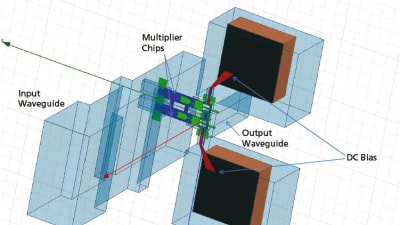
A 1.6-THz power-combined Schottky frequency tripler was designed to handle approximately 30 mW input power. The design of Schottky-based triplers at this...
Briefs: Electronics & Computers
JPL has produced a series of FPGA (field programmable gate array) vision algorithms that were written with custom interfaces to get data in and out of each vision module. Each module has unique requirements on the data interface, and further vision modules are continually being developed, each with their own custom...
Briefs: Mechanical & Fluid Systems
The design of machines that rely on arrays of servomotors such as robotic arms, orbital platforms, and combinations of both, imposes a heavy computational burden to coordinate their actions to perform coherent tasks. For example, the robotic equivalent of a person...
Briefs: Mechanical & Fluid Systems
This invention is a magnetically actuated seal in which either a single electromagnet, or multiple electromagnets, are used to control the seal’s position. This system can either be an open/close type of system or an actively controlled system.
Briefs: Mechanical & Fluid Systems
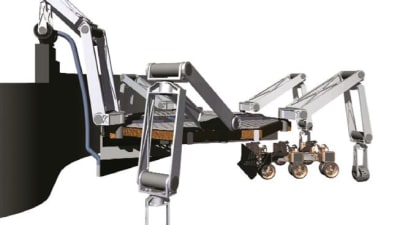
The Regolith Advanced Surface Systems Operations Robot (RASSOR) excavator robot is a teleoperated mobility platform with a space regolith excavation capability. This more compact, lightweight design (
Briefs: Mechanical & Fluid Systems
A lightweight, cryogenically capable, scalable, deformable mirror has been developed for space telescopes. This innovation makes use of polymer-based membrane mirror technology to enable large-aperture mirrors that can be easily launched and...
Briefs: Physical Sciences
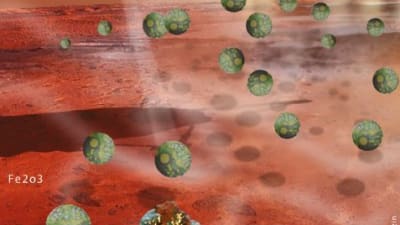
A revolutionary way is proposed of studying the surface of Mars using a wind-driven network of mobile sensors: GOWON. GOWON would be a scalable, self-powered and...
Briefs: Physical Sciences
Investigation of sonic boom has been one of the major areas of study in aeronautics due to the benefits a low-boom aircraft has in both civilian and military applications. Current Federal Aviation Administration regulations prohibit supersonic flight over land due to...
Briefs: Physical Sciences
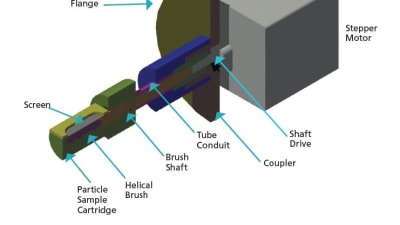
Particle seeding is a key diagnostic component of filter testing and flow imaging techniques. Typical particle generators rely on pressurized air or gas sources to propel the particles into the flow field. Other...
Briefs: Software
A system was developed to provide a new mechanism for members of the mission community to create and contribute new science data to the rest of the community. Mission tools have allowed members of the mission community to share first order data (data that is created by the...
Briefs: Software
This software is a viewer program for maritime robotics software that provides a 3D visualization of the boat pose, its position history, ENC (Electrical Nautical Chart) information, camera images, map overlay, and detected tracks.
Briefs: Software
This software provides storage retrieval and analysis functionality for managing satellite altimetry data. It improves the efficiency and analysis capabilities of existing database software with improved flexibility and documentation. It offers flexibility in the type of data that can be stored. There is efficient retrieval...
Briefs: Software
This work covers two programs that accomplish the same goal: creation of a “reachability map” from stereo imagery that tells where operators of a robotic arm can reach or touch the surface, and with which instruments. The programs are “marsreach” (for MER) and “phxreach.” These programs make use...
Briefs: Software
A flight-qualified implementation of a Software Defined Radio (SDR) Operating Environment for the JPL-SDR built for the CoNNeCT Project has been developed. It is compliant with the NASA Space Telecommunications Radio System (STRS) Architecture Standard, and provides the software...
Briefs: Software
RFI-SIM simulates the RFI environment to estimate the interference from terrestrial emitters into spacecraft, or vice versa. A high-fidelity simulation of the RFI environment has been developed by employing all antenna-related and radar systemrelated parameters of multiple emitters, as well as that of the desired...
Briefs: Information Technology
The configuration of ION (Interplanetary Overlay Network) network nodes is a manual task that is complex, time-consuming, and error-prone. This program seeks to accelerate this job and produce reliable configurations.
Briefs: Software
This software runs a suite of arbitrary software tests spanning various software languages and types of tests (unit level, system level, or file comparison tests). The dtest utility can be set to automate periodic testing of large suites of software, as well as running individual tests. It supports distributing multiple tests...
Briefs: Software
IMPaCT enables comprehensive information on current NASA missions, prospective future missions, and the technologies that NASA is investing in, or considering investing in, to be accessed from a common Web-based interface. It allows dependencies to be established between missions...
Briefs: Software
A framework of software components has been implemented to facilitate the development of ISHM systems according to a methodology based on Reliability Centered Maintenance (RCM). This framework is collectively referred to as the Toolkit and was developed using General Atomics’ Health MAP™...
Briefs: Information Technology
Modeling and imaging the Earth’s ionosphere as well as understanding its structures, inhomogeneities, and disturbances is a key part of NASA’s Heliophysics Directorate science roadmap. This invention provides a design tool for...
Briefs: Information Technology
There have been a number of missions with spacecraft flying by planetary moons with atmospheres; there will be future missions with similar flybys. When a spacecraft such as Cassini flies by a moon with an atmosphere, the spacecraft will experience an atmospheric torque. This torque could be...

 INSIDER: Medical
 Features: Medical
 Features: Materials
 From the Editor: Medical
 INSIDER: Medical
 Features: AR/AI

 Podcasts: Medical
 Podcasts: Medical
 Podcasts: Design
 On-Demand Webinars: Manufacturing & Prototyping
 Podcasts: AR/AI
 Podcasts: Green Design & Manufacturing
