Robots may soon have a new way to communicate with people. Not through words or screens, but with light and images projected directly onto the world around them. University of South Florida's Zhao Han is developing technology that could transform how people interact with robots in both emergencies and everyday life. Read on to learn more.
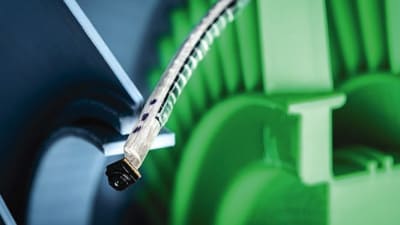
Researchers at the University of California San Diego have developed a soft robotic skin that enables vine robots that are just a few millimeters wide to navigate convoluted paths and fragile environments. Read on to learn more.
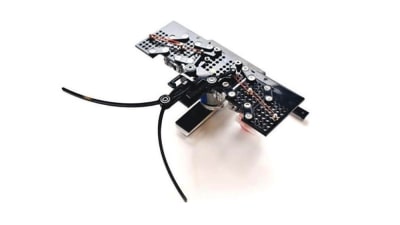
Mechanical engineering researchers in the Harvard John A. Paulson School of Engineering and Applied Sciences think there’s another way to design robots: Programming intended functions directly into a robot’s physical structure, allowing the robot to react to its surroundings without the need for extensive on-board electronics. Read on to learn more.
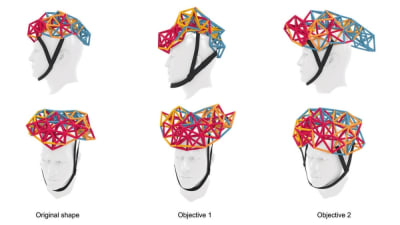
A team of UC Berkeley-led researchers has developed an AI-driven framework to optimize and automate the design of complex truss robots. This approach enables designers to create robots with extraordinary capabilities while maximizing control efficiency. Read on to learn more about it.
Missions to the moon and other planets will require large-scale infrastructure that would benefit from autonomous assembly by robots without on-site human intervention. NASA Ames Research Center has developed a novel and efficient mobile bipedal robot system to construct low-mass, high precision, and largescale infrastructure. Read on to learn more.
Application Briefs: Robotics, Automation & Control
Finland-based Metos Oy, a manufacturer of professional stainless steel kitchen equipment, needed a welding solution that could deliver flawless, pressure-rated welds for small batches of high-spec products, which feature tubular structures and circular shafts that required continuous, precision welding. Read on to find out what they did.
Without integrated vision, robots can only perform tasks in precisely the same way every time. If a part is even slightly out of position or rotated differently, the robot may fail to complete its task, or worse, cause an error in the process. Read on to learn more.
Battery packs are becoming larger and heavier, particularly in applications such as electric trucks, aviation and renewable energy storage. As payload requirements increase, manufacturers are turning to advanced automation and material handling systems to keep pace. Read on to learn what this means.
See the new products, including Plasmatreat's HydroPlasma, a solution for the removal of stubborn contaminants from glass and metal surfaces; TDK Corporation's 3000-watt TDK-Lambda brand HWS3000G programmable AC-DC power supplies; Zircotec's new range of proprietary ceramic coatings; Thermo Fisher Scientific's expanded solutions for battery manufacturers; and more.
By flipping a foundational belief in battery design, Hailong Chen and his team found that charging zinc-ion batteries at higher currents can make them last longer. Read on to learn more about this surprising result.
Read on to learn about research that raises the benchmark for sodium-based all-solid-state batteries and demonstrates thick cathodes that retain performance at room temperature down to subzero conditions.
Will EV sales in the U.S. double by the end of the decade, or more? Will the U.S. keep pace with China’s relentless iterative improvements on EV technology, or will China increasingly dominate the rapidly electrifying global transportation industry? Read on to learn more.
Oak Ridge National Laboratory researchers have overcome a barrier to using a more affordable, dry process for manufacturing the Li-ion batteries used in vehicles and electronic devices. The resulting batteries provide greater electricity flow and reduced risk of overheating. Read on to learn more.
Today’s electric vehicle boom is tomorrow’s mountain of electronic waste. And while myriad efforts are underway to improve battery recycling, many EV batteries still end up in landfills. A research team from MIT wants to help change that with a new kind of self-assembling battery material that quickly breaks apart when submerged in a simple organic liquid. Read on to learn more.
Traditionally, most motors used in EVs and mobility platforms have been radial flux systems. In recent years, there have been major strides in alternative axial flux motor architectures. What exactly do these architectural differences mean for motor design and production? Read on to find out.
Siemens Healthineers and Stryker have entered into a strategic partnership in the field of neurovascular robotics. The collaboration aims to develop a...
Lockheed Martin Skunk Works®, with industry partners and the U.S. Air Force, controlled an uncrewed aerial system (UAS) from the cockpit of a fifth generation fighter jet while in flight.
Boston Scientific Corporation has entered into a definitive agreement to acquire Nalu Medical, Inc., a privately held medical technology company focused on developing and commercializing...
This might seem like an obvious statement, but designing an aircraft that flies at five to seven times the speed of sound is difficult. Paradoxically, materials for...
Spider silk spins new life into nerve repair…3D‐printed implants help repair spinal cord injuries…plasma pen transforms adhesion in medical device manufacturing. Read about these and...
This compendium of articles from the editors of Tech Briefs and Aerospace & Defense Technology magazines looks at the latest advances in power electronics and energy storage for applications ranging from...
Master Bond EP30NS is a nanosilica filled epoxy system featuring high abrasion resistance. Independent tests demonstrate that this epoxy’s abrasion resistance value is significantly higher than that of a typical...
On the latest episode of the Aerospace & Defense Technology podcast, we sit down with two experts from Dassault Systèmes: Mariah Otte, Aerospace & Defense Solution Architect, and Jason Roberson, Industry Value Expert. Listen now!
Researchers at the University of Sydney and start-up Dewpoint Innovations have developed a nanoengineered polymer paint-like coating that can passively cool buildings and capture water directly from the air — all without energy input.
Improving extruded components requires careful attention to a number of factors, including dimensional tolerance, material selection, and processing. Trelleborg’s Dan Sanchez provides detailed insights into each of these considerations to help you advance your device innovations while reducing costs and speeding time to market.
Inside Story: Trends in Packaging and Sterilization
Eurofins Medical Device Testing (MDT) provides a full scope of testing services. In this interview, Eurofins’ experts, Sunny Modi, PhD, Director of Package Testing; and Elizabeth Sydnor, Director of Microbiology; answer common questions on medical device packaging and sterilization.

















 INSIDER: Medical
 Features: Medical
 Features: Materials
 From the Editor: Medical
 INSIDER: Medical
 Features: AR/AI

 Podcasts: Medical
 Podcasts: Medical
 Podcasts: Design
 On-Demand Webinars: Manufacturing & Prototyping
 Podcasts: AR/AI
 Podcasts: Green Design & Manufacturing
