Articles: Mechanical & Fluid Systems
The design of avionics systems must balance several factors. First, engineers want to increase the performance of the systems installed in aircraft or spacecraft. Second, they want to...
Briefs: Imaging
Magnetic resonance imaging (MRI) uses magnetic fields and radio waves to create images of organs and tissues in the human body, helping doctors diagnose potential problems or diseases. Doctors use MRI to...
Briefs: Materials
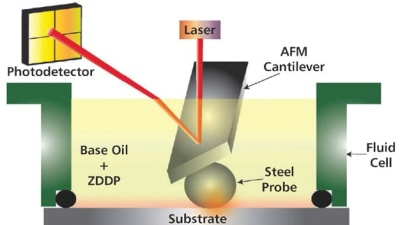
Different instruments are needed to study the interaction of contact surfaces at different length scales. Tribometers measure the coefficient of friction but they cannot...
Articles: Materials
Your new industrial electronic product has been designed and the board components specified. It has been prototyped, either on a development board to check functionality...
Articles: Automotive
Semi-Liquid Metal Anode for Next-Generation Batteries
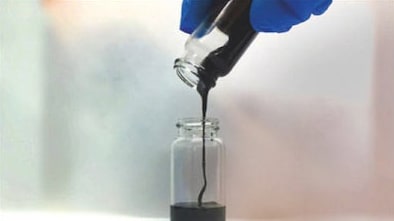
Researchers from Carnegie Mellon University have developed a semi-liquid lithium metal-based anode. Lithium batteries made using this new electrode type could have a...
Briefs: Test & Measurement
At the scale of bridges or buildings, the most important force that engineered structures need to deal with is gravity. But at the scale of microelectro-mechanical systems (MEMS) — devices like the...
Briefs: Electronics & Computers
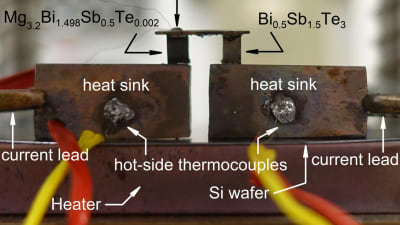
The widespread adoption of thermoelectric devices that can directly convert electricity into thermal energy for cooling and heating has been hindered, in part, by the lack of...
Briefs: Robotics, Automation & Control
Robotics has traditionally focused on industrial applications in which robots require strength and precision to carry out repetitive tasks. These robots flourish in highly...
Briefs: Propulsion
Landing is stressful on a rocket’s legs because they must handle the force from the impact with the landing pad. One way to combat this is to build legs out of materials that absorb some of the...
Briefs: Electronics & Computers
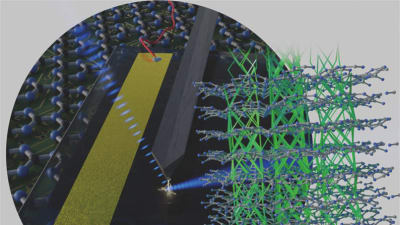
Some organic materials cannot be utilized similarly to silicon semiconductors in optoelectronics. Whether in solar cells, light-emitting diodes, or in transistors, what is important is the bandgap, i.e. the...
Briefs: Electronics & Computers
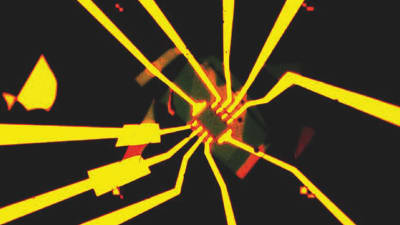
Recently discovered two-dimensional (2D) materials with superlative properties have the potential to advance semiconductors but creating 2D devices with both good electrical contacts and...
Briefs: Imaging
A novel patch antenna technology was developed that provides significant benefits to NASA satellite communication applications, offering a unique wide-band/multi-band operating capability. For other non-space applications, the antenna design also offers broadband capability with high gain for...
Briefs: Materials
Unlike water, liquid refrigerants and other fluids that have a low surface tension spread quickly into a sheet when they come into contact with a surface. For many industrial processes,...
Briefs: Materials
While different approaches have been used to create artificial muscles — including hydraulic systems, servomotors, shape-memory metals, and polymers that respond to stimuli — they all have limitations such as...
Briefs: Electronics & Computers
For complex boards with multiple FPGAs, each FPGA can implement its own remote terminal (RT) core and present itself logically to the bus as a remote terminal while sharing the RT’s hardware. This simplifies the design since commands and telemetry do not have to be distributed and collected by user logic;...
Technical Innovation: Manned Systems
In a still-heated market for highly profitable heavy-duty pickups and commercial vehicles, Ford doesn’t intend to be outdone by General Motors’ and FiatChrysler’s...
Briefs: Mechanical & Fluid Systems
Antenna characterization techniques are often expensive and time-consuming. NASA’s Glenn Research Center developed a highly versatile and automated system to perform characterization of single or multiple small circuit antennas, printed on-wafer or on other substrates, by measuring the antenna’s...
Briefs: RF & Microwave Electronics
A self-configurable radio receiver system was developed for relaying communication signals from multiple deep space assets. Most conventional radio receivers are hardwired to receive a specific type of signal and are incapable of receiving other types of signals without preconfiguration according...
Briefs: Mechanical & Fluid Systems
A soft and conformable health monitor can broadcast electrocardiogram (ECG), heart rate, respiratory rate, and motion activity data as much as 15 meters to a portable recording device...
Briefs: Motion Control
The Advanced Explosive Ordnance Disposal Robotic System (AEODRS) features a modular open systems architecture that enables the robot to be self-righting after a fall. The self-righting...
Briefs: Mechanical & Fluid Systems
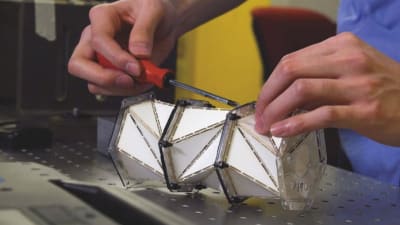
In the future, soft, animal-inspired robots may be safely deployed in difficult-to-access environments in which rigid robots cannot currently be used such as inside the human body or in spaces that are too...
Briefs: Test & Measurement
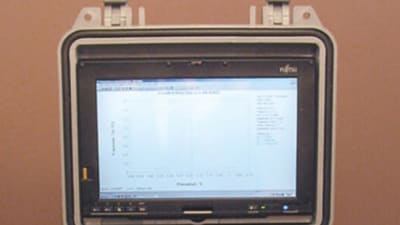
A portable, stable, standards-quality radiation thermometer was invented that can measure temperatures between -50 °C (-58 °F) to 150 °C (302 °F). The corresponding infrared wavelengths...
Briefs: Manufacturing & Prototyping
In order to qualify miniature springs, manufacturers of these systems rely on commercially available testers that are designed for large-scale springs (>0.5" diameter). Commercially available spring test...
Briefs: Materials
An electrochemical sensing system that significantly improves the ability to rapidly and accurately detect heavy metals in biological and environmental samples was developed. Using a simple blood sample...
Facility Focus: Sensors/Data Acquisition
The Georgia Tech Research Institute (GTRI) is the nonprofit applied research division of the Georgia Institute of Technology (Georgia Tech) in Atlanta, GA. Founded in 1934 as the Engineering...
Briefs: Sensors/Data Acquisition
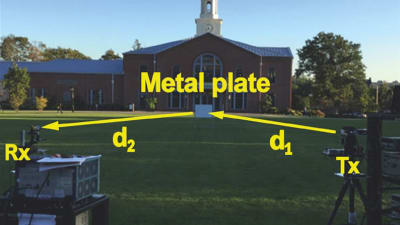
Today’s cellular networks and Wi-Fi systems rely on microwave radiation to carry data but the demand for more bandwidth is quickly becoming more than microwaves can handle. That has...
Articles: Manufacturing & Prototyping
No longer just a buzzword, the Internet of Things (IoT) is rapidly taking hold in many different industries, from aerospace and automotive, to medical and manufacturing. The IoT ecosystem incorporates...
Briefs: Photonics/Optics
Accurately detecting, locating, and quantifying leaks of methane — the main component of natural gas and a major fuel source worldwide — is critically important for both environmental and...
Q&A: Mechanical & Fluid Systems
Robert F. Shepherd is Associate Professor of Mechanical and Aerospace Engineering at Cornell University in Ithaca, NY. He is leading a team exploring the use of hydraulic fluids in soft robots to also serve...














 INSIDER: Medical
 Features: Medical
 Features: Materials
 From the Editor: Medical
 INSIDER: Medical
 Features: AR/AI

 Podcasts: Medical
 Podcasts: Medical
 Podcasts: Design
 On-Demand Webinars: Manufacturing & Prototyping
 Podcasts: AR/AI
 Podcasts: Green Design & Manufacturing
