INSIDER

-1
990
30
INSIDER: Medical
Researchers Develop Artificial Blood Vessels
Vienna University of Technology and Vienna Medical University researchers have created artificial blood vessels from a special elastomer material. To produce the vascular prostheses, polymer solutions were spun in an electrical field to form very fine threads and wound onto a spool. The prostheses can...
INSIDER: Medical
Portable MRI Uses Low-Power Magnetic Fields
A portable Magnetic Resonance Imaging (MRI) device from the Los Alamos National Laboratory uses low-power magnetic fields to image the brain and other soft-tissue anatomy. The lightweight technology could be deployed on the battlefield and in the world's poorest regions.
INSIDER: Medical
NIST Team Identifies 3D-Printing Intricacies
Manufacturing researchers at the National Institute of Standards and Technology (NIST) have identified important challenges for powder bed fusion, the chief method for "printing" metal parts. By identifying the factors that influence the manufacturing process, professionals will improve the creation of...
INSIDER: Medical
Portable Breath Test Detects Cancers
A portable device, developed in part by EPFL researchers, monitors one's breath to quickly detect the presence of head and neck cancer. The technology, equipped with extremely sensitive sensors, has been tested on patients and operates with a computer or even a mobile phone.
INSIDER: Medical
New Fabrication Technique Prints Silicon on Paper
Using a single laser pulse, a group of researchers at Delft University of Technology in The Netherlands has devised a method that allows silicon, in the polycrystalline form used in circuitry, to be produced directly on a paper substrate from liquid silicon ink. The process can be expanded to create...
INSIDER: Robotics, Automation & Control
Inkjet Technology Prints 'Soft Robot' Circuits
A new potential manufacturing approach from Purdue University researchers harnesses inkjet printing to create devices made of liquid alloys. The resulting stretchable electronics are compatible with soft machines, such as robots that must squeeze through small spaces, or wearable electronics.
INSIDER: Medical
Camera Chip Provides High-Depth 3D Resolution
Using an inexpensive silicon chip less than a millimeter square in size, a nanophotonic coherent imager (NCI), developed by California Institute of Technology researchers, provides 3D maps with high depth-measurement accuracy.
INSIDER: Medical
Biosensing Platform Quickly Diagnoses Disease
A biosensing platform from Florida Atlantic University could be used to diagnose disease, remotely monitor patients, and determine treatment options for HIV, E-coli, Staphylococcus aureas, and other bacteria. Using a drop of blood from a fingerprick, the platform provides clinically relevant...
INSIDER: Medical
Gas-Sensing Capsules Monitor Gut
Royal Melbourne Institute of Technology (RMIT) University researchers have developed gas-sensing capsules that send data from inside the gut directly to a mobile device. To measure the concentration of selected intestinal gases, the capsule includes a built-in gas sensor, microprocessor, and wireless high-frequency...
INSIDER: Medical
Additive Manufacturing Improves Glucose Sensor
Engineers at Oregon State University have used additive manufacturing to create an improved glucose sensor for Type 1 diabetes patients. Matched with portable infusion pumps, the new system monitors blood glucose concentrations, delivers insulin, and maintains safe hormone levels.
INSIDER: Robotics, Automation & Control
Non-Invasive Method Detects Cancerous Cells
Using MRI, Johns Hopkins researchers developed a cancer detection method that does not rely on injected contrast dyes. The technique noninvasively finds telltale sugar molecules shed by the outer membranes of cancerous cells.
INSIDER: Medical
VA Study to Test Light Therapy on Brain Function
To address brain damage caused by explosions and neurotoxin exposure, researchers at the VA Boston Healthcare System are testing the effects of light therapy. Veterans in the study wear a helmet lined with light-emitting diodes that apply red and near-infrared light to the scalp. Diodes, placed in...
INSIDER: Medical
New Microscopy Technique Zooms in on Organs
A biomedical engineer at UNSW Australia uses semiconductor technology to view organs of the human body, down to the level of a single cell. The imaging technology, developed by optical and industrial measurement manufacturer Zeiss, was originally created to scan silicon wafers for defects.
INSIDER: Medical
Implantable Micropacemaker Resides Entirely Within Fetus
A team of investigators at Children’s Hospital Los Angeles and the University of Southern California have developed an implantable micropacemaker designed for use in a fetus. The micropacemaker, designated a Humanitarian Use Device by the US Food & Drug Administration (FDA), will...
INSIDER: Medical
Bioplastics Demonstrate Antibacterial Properties
According to a recent study by the University of Georgia College of Family and Consumer Sciences, bioplastics made from protein sources have shown significant antibacterial properties. The materials could be used in medical applications, such as wound healing dressings, sutures, catheter tubes, and...
INSIDER: Medical
Artificial Hand Features Muscle-Like Wires
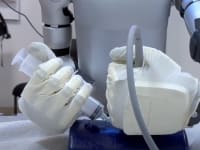
Inspired by nature, Saarland University researchers have equipped an artificial hand with muscles made from shape-memory wire. The new technology enables the fabrication of flexible and lightweight robot hands for industrial applications and novel prosthetic devices.
INSIDER: Medical
Infrared Imaging Technique Paints Tissue Samples with Light
Using a combination of advanced microscope imaging and computer analysis, a new technique from University of Illinois researchers gives pathologists a window into the structures and molecules inside tissues and cells. The fast diagnostic assessments are done without using chemical stains...
INSIDER: Medical
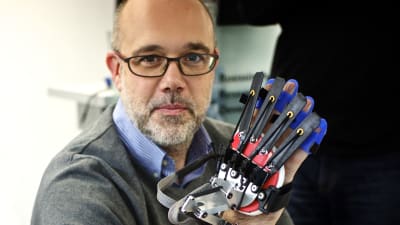
Researchers at the University of Hertfordshire have developed a robotic glove prototype for stroke sufferers. The device can be used in homes to support rehabilitation and personal independence.
Feature Image
INSIDER: Medical
The European Space Agency (ESA) has adapted a high-speed camera to detect changes in human skin cells. Developed for ESA by the Belgian company Xenics, the Proba-V camera allows the small...
Feature Image
INSIDER: Medical
University of Maryland researchers have developed a spray-on material that stretches and reliably conducts electricity. The process could be used in electronic fabrics or artificial skin.
Feature Image
INSIDER: Medical
FDA Amends Reporting Rules to Align with UDI Program
Medical device regulators at the FDA have issued correcting amendments to their post-market electronic Medical Device Reporting (eMDR) requirements to eliminate any disparities between those rules and their Unique Device Identification (UDI) system.
INSIDER: Medical
Reprocessing Reusable Medical Devices
The U.S. Food and Drug Administration announced new actions to enhance the safety of reusable medical devices and address the possible spread of infectious agents between uses. FDA’s guidance document, titled “Reprocessing Medical Devices in Health Care Settings: Validation Methods and Labeling” includes...
INSIDER: Medical
Medical System-on-a-Chip Reduces Hardware Failure Rate
The Desyre project couples a reconfigurable substrate with runtime-system software support in such a manner that the medical system-on-a-chip can adapt on demand to various types and densities of faults, system constraints, and application requirements.
INSIDER: Medical
Researchers Use Magnetic Fields to Stimulate Brain Tissue
Researchers at MIT have developed a method to stimulate brain tissue using external magnetic fields and injected magnetic nanoparticles. The technique allows direct stimulation of neurons, which could be an effective treatment for a variety of neurological diseases, without the need for...
INSIDER: Medical
Researchers Developing Bionic Heart
Scientists at the Texas Heart Institute are working to create a permanent artificial heart.
INSIDER: Robotics, Automation & Control
Robotic Ankle Keeps an Eye on the Road
Mo Rastgaar, a Michigan Technological University mechanical engineer, and his team have developed a robotic ankle that "sees" where it is going.
INSIDER: Robotics, Automation & Control
Artificial 'Smart Skin' Detects Subtle Pressures
A Seoul National University professor developed a synthetic technology that reproduces the sense of touching real human skin. The artificial skin senses pressure, temperature, strain, and humidity. The soft material is also embedded with self-heating elements.
INSIDER: Medical
New Material Self-Stretches
A University of Rochester team has fabricated a material that self-stretches as it cools. The rubber-like polymer reverts back to its original shape when heated.
INSIDER: Medical
Bioengineers Create 'Heart-on-a-Chip'
A “heart-on-a-chip,” built by UC Berkeley bioengineers, houses human heart tissue derived from adult stem cells. The system could one day replace animal models for drug safety screening.

Ask the Expert

Dan Sanchez on How to Improve Extruded Components

Feature Image

Improving extruded components requires careful attention to a number of factors, including dimensional tolerance, material selection, and processing. Trelleborg’s Dan Sanchez provides detailed insights into each of these considerations to help you advance your device innovations while reducing costs and speeding time to market.

Inside Story

Inside Story: Trends in Packaging and Sterilization

Feature Image

Eurofins Medical Device Testing (MDT) provides a full scope of testing services. In this interview, Eurofins’ experts, Sunny Modi, PhD, Director of Package Testing; and Elizabeth Sydnor, Director of Microbiology; answer common questions on medical device packaging and sterilization.

Videos