
Inside this issue
Overview
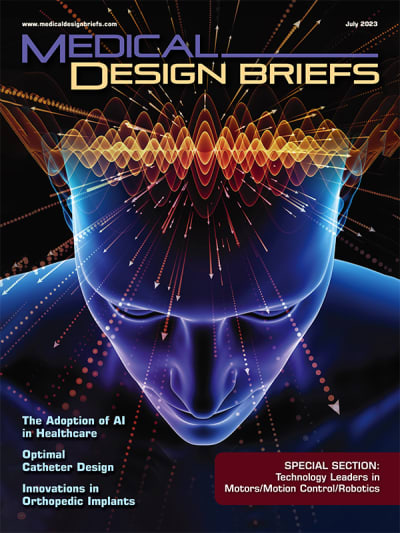
The July 2023 issue of Medical Design Briefs presents a comprehensive overview of the latest advancements and innovations in medical technology, focusing on the integration of robotics, motion control, and design considerations for medical devices. This issue emphasizes the critical role that technology plays in enhancing patient care and improving healthcare outcomes.
One of the key highlights of this issue is the exploration of electric linear actuators, which are becoming increasingly important in medical devices. These actuators enable both simple and complex controlled movements, which are essential for various applications, including surgical robots and radiation treatment devices. The article by Ryan Klemetsen and John Fenske from Tolomatic, Inc. discusses how designers can go beyond mere performance specifications to consider factors such as operating environments, human factors, and long-term serviceability. This holistic approach ensures that medical devices are not only effective but also safe and reliable for patients and healthcare professionals.
The issue also features a free white paper titled “Linear Motion Design Considerations for Medical Device OEMs,” which provides deeper insights into the successful design and integration of linear motion in medical applications. This resource is invaluable for original equipment manufacturers (OEMs) looking to enhance their product offerings in the medical field.
In addition to linear actuators, the magazine delves into the realm of robotics with a focus on the French startup Enchanted Tools. Founded by Jérôme Monceaux, who has a background in creating humanoid robots like Pepper and Nao, Enchanted Tools introduces Miroki, a prototype of a new generation of humanoid robots. These robots are designed to be both wondrous and useful, addressing the challenge of fully integrating robotics into daily life. The potential applications of such robots in healthcare settings are vast, ranging from patient assistance to rehabilitation support.
The issue also touches on the importance of precision in medical treatments, particularly in the context of cancer therapy. The use of custom electric actuators allows for motion control to within 1 micrometer, enabling radiation treatment devices to precisely focus radiation beams on cancerous cells. This level of precision is crucial for minimizing damage to surrounding healthy tissue and improving treatment outcomes for patients.
Furthermore, the magazine highlights the ongoing advancements in orthopedic implants, showcasing how new materials and designs are enhancing the performance and longevity of these devices. Innovations in this area are critical as they directly impact patient recovery times and overall satisfaction with surgical outcomes.
The editorial section of the magazine provides insights into the broader trends shaping the medical device industry, including the increasing emphasis on patient-centered design and the integration of artificial intelligence (AI) in medical technologies. AI is being leveraged to improve diagnostics, personalize treatment plans, and streamline operations within healthcare facilities. The potential for AI to transform patient care is immense, and the magazine discusses various case studies and applications that illustrate its impact.
Additionally, the issue features an advertisers index, providing readers with information on companies and products that are leading the way in medical technology. This section serves as a valuable resource for professionals in the industry looking to stay informed about the latest offerings and innovations.
Overall, the July 2023 issue of Medical Design Briefs serves as a vital resource for healthcare professionals, engineers, and designers involved in the medical device industry. It encapsulates the current state of technology in healthcare, emphasizing the importance of innovation, precision, and patient-centered design. As the industry continues to evolve, the insights and information presented in this issue will be instrumental in guiding the development of future medical technologies that enhance patient care and improve health outcomes.
In conclusion, this issue not only highlights the technological advancements in medical devices but also underscores the collaborative efforts of engineers, designers, and healthcare professionals in creating solutions that meet the growing needs of patients and the healthcare system. The future of medical technology is bright, and the innovations discussed in this issue are paving the way for a new era of healthcare.
Features
-
Articles
6 Catheters: How to Achieve Optimal Hypotube Design
10 Innovations Drive Improved Orthopedic Prosthetic Implants
-
R & D
23 New Class of Microrobots Could Travel in the Body
23 3D Imaging Sensor Offers High Angular Resolution
23 Deployable Electrodes for Minimally Invasive Craniosurgery
23 Bioinspired Imaging Sensor Advances FGS
24 Flexible Sweat Sensor Based on Photonic Cellulose Nanocrystal
-
From the Editor
4 From the Editor - How 3D Printing Could Improve Spinal Surgery
-
Applications
35 Increasing Throughput and Inspection Information with Automated 3D Scanning Technology
-
Technology Leaders
14 Enchanted Tools: Revolutionizing Robotics with Mirokai
17 Linear Motion Design Considerations for Medical Device OEMs
-
Videos of the Month
Tech Briefs
-
25 The Adoption of Acoustic AI in Healthcare
26 Disruption Is on the Horizon: Trends in Precision Surgery
28 Engineers Develop Low-Cost Human Biomarker Sensor Designs
29 Artificial Intelligence: Making Innovations Fit for the MDR
30 Thermoelectric Generator: Reliable Power for Wearable Electronics
32 Leveraging Edge Computing and Wearable Devices in Clinical Trials
34 Brain Computer Interface Helps Immobilized Patients Control Devices
42 Stretchable Knee Wearable Offers Insight into Improving e-Textiles for Healthcare