
Inside this issue
Overview
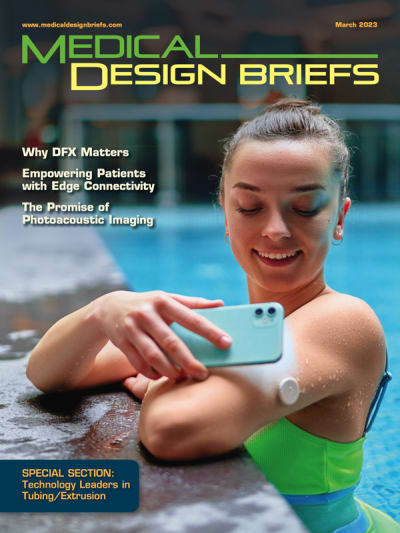
The March 2023 issue of Medical Design Briefs presents a comprehensive overview of the latest advancements and trends in medical technology, focusing on how innovative designs and connectivity solutions are transforming patient care and healthcare delivery.
Key Highlights:
-
Edge Connectivity and Patient Empowerment: The issue opens with a feature on edge connectivity, emphasizing its role in empowering both patients and healthcare providers. The integration of connected medical devices allows for smarter health decisions, enabling remote patient monitoring and real-time data collection. This shift is particularly significant in light of recent healthcare challenges, such as the COVID-19 pandemic, where remote monitoring has proven to improve care, reduce costs, and significantly lower hospitalization rates.
-
Design for Excellence (DFX): A critical column discusses the importance of DFX in the medical device development process. It highlights how a phase zero approach can streamline design efforts, allowing teams to quickly generate and evaluate concepts. This iterative redesign process can lead to more efficient production methods, as demonstrated by a case study where a complex device was simplified to just seven components, making it automation-compatible and scalable to production volumes of 600,000 devices per year.
-
Innovative Medical Applications: The magazine features several innovative medical applications, including:
- Wearable Skin Patches: These patches are designed to monitor hemoglobin levels in deep tissues, showcasing the potential for non-invasive health monitoring.
- High-Power Electrostatic Actuators: These actuators are being developed to create artificial muscles, which could revolutionize prosthetics and robotic applications.
- Mobile Photoacoustic Imaging: This emerging technology promises to enhance imaging capabilities in various medical fields, providing clearer and more detailed images for diagnostics.
Connected NFC Technology: The issue also delves into the use of connected NFC (Near Field Communication) tags, which offer tap-and-go connectivity for personal-use medical devices. These tags can link to the cloud without requiring an external power source, thanks to their energy-harvesting features. This technology is crucial for maintaining the functionality of devices over extended periods, ensuring they remain effective in delivering quality care.
-
Challenges in Medical Device Assembly: A detailed article discusses the complexities involved in assembling medical devices, particularly those requiring precision components like optical windows. The challenges of automation compatibility and the need for meticulous assembly processes are highlighted, along with strategies to overcome these hurdles through innovative design approaches.
-
R&D Roundup and New Products: The R&D Roundup section provides insights into the latest research and development efforts in the medical field, showcasing new products and services that are hitting the market. This includes advancements in materials, manufacturing processes, and device functionalities that aim to enhance patient outcomes and streamline healthcare operations.
-
Global Innovations: The magazine features a special section on global innovations in tubing and extrusion technologies, highlighting the contributions of various industry leaders. This section underscores the importance of high-performance materials in medical applications, which are essential for ensuring the safety and efficacy of medical devices.
-
Advertisers and Industry Insights: The issue concludes with an advertisers index, providing readers with resources and contacts for further exploration of the products and services mentioned throughout the magazine. This section serves as a valuable tool for professionals seeking to connect with industry leaders and stay updated on the latest offerings in medical technology.
Conclusion:
The March 2023 issue of Medical Design Briefs serves as a vital resource for professionals in the medical technology field, offering insights into the latest trends, challenges, and innovations. With a strong focus on connectivity, design excellence, and emerging technologies, this issue highlights the ongoing evolution of healthcare and the critical role that advanced medical devices play in improving patient care. As the industry continues to adapt to new challenges, the information presented in this issue will be instrumental in guiding future developments and fostering collaboration among healthcare providers, engineers, and researchers.
Features
-
Articles
10 Edge Connectivity Empowers Patients, Healthcare Providers to Make Smarter Health Decisions
14 Consider Phase Zero: The Importance of DFX to Meet Deadlines, Deliverables
-
R & D
30 MicroLED Patch for Melanogenesis
30 Sensor Detects Heavy Metals in Sweat
30 Glucose Meter Monitors SARS-CoV-2 Antibodies
30 Temporary Tattoos Measure Blood Pressure
-
Global Innovations
42 Analyzing Sweat via Microelectronic Fibers for Noninvasive Health Monitoring
-
From the Editor
-
Technology Leaders
18 High-Performance Crosslinkable Thermoplastic Elastomers for Medical Applications
Tech Briefs
-
32 Medical App Development: Top 3 mHealth Solutions
35 Wearable Skin Patch Monitors Hemoglobin in Deep Tissues
36 High-Power Electrostatic Actuators to Realize Artificial Muscles