
Inside this issue
Overview
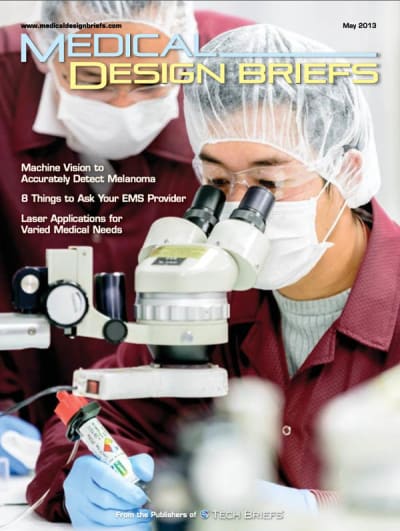
The May 2013 issue of Medical Design Briefs presents a wealth of information and insights into the latest advancements in medical technology and design. This edition features a variety of articles that cover critical topics, including machine vision for melanoma detection, innovations in cardiac monitoring, and the role of laser technologies in medical applications.
Key Features
-
Machine Vision for Melanoma Detection: One of the standout articles discusses how machine vision technology is being utilized to detect melanoma at its most curable stage. This technology leverages advanced imaging techniques and algorithms to analyze skin lesions, providing healthcare professionals with a powerful tool for early diagnosis. The article emphasizes the importance of early detection in improving patient outcomes and highlights ongoing research and development in this area.
-
Cardiac Monitoring Innovations: Another significant feature addresses the removal of leads in cardiac monitoring. Traditional cardiac monitoring often requires invasive leads, which can be uncomfortable for patients. The article explores new technologies that enable non-invasive monitoring, improving patient comfort and compliance. This innovation is particularly relevant for patients requiring long-term monitoring, as it reduces the risk of infection and enhances the overall patient experience.
-
Choosing an EMS Provider: The issue includes a practical guide titled "Eight Things to Look for in a Medical Device EMS Provider." This article serves as a valuable resource for design engineers and medical device manufacturers, outlining essential criteria for selecting an electronics manufacturing services (EMS) provider. Key considerations include the provider's experience, quality assurance processes, and ability to meet regulatory requirements. This guidance is crucial for ensuring that medical devices are produced efficiently and to the highest standards.
Laser Technologies in Medical Applications: The magazine also features an article on laser technologies that support diverse applications in medical and biophotonics fields. Lasers are increasingly being used for various medical procedures, including surgery, diagnostics, and therapeutic applications. The article discusses the advantages of laser technology, such as precision, minimal invasiveness, and reduced recovery times, making it a preferred choice in many medical settings.
-
Tech Briefs: The issue includes several tech briefs that highlight cutting-edge innovations. Notable mentions include:
- Choosing Chiller Pumps for Medical Lasers: This brief discusses the importance of temperature control in laser applications and how selecting the right chiller pump can enhance performance and reliability.
- Hand-Based Biometric Analysis: This technology is explored for its potential in patient identification and security, showcasing how biometric systems can improve healthcare delivery.
- Micro-Endoscope Development: A new micro-endoscope, as thin as a human hair, is introduced, which promises to revolutionize minimally invasive procedures by providing high-resolution imaging in confined spaces.
- New Material for Improved Ultrasound: The introduction of a new material that enhances ultrasound imaging capabilities is discussed, highlighting its potential to improve diagnostic accuracy.
Departments and Additional Content
The magazine also features various departments that provide updates on global innovations, new products, and a column from the editor that sets the tone for the issue. The "Mission Accomplished" section celebrates successful projects and innovations in the medical design field, while the "Global Innovations" department showcases groundbreaking technologies from around the world.
Advertisers Index and Subscription Information
The issue concludes with an advertisers index, providing readers with information on companies and products featured in the magazine. Subscription details are also included, offering options for both domestic and international readers.
Conclusion
Overall, the May 2013 issue of Medical Design Briefs serves as a comprehensive resource for professionals in the medical design and engineering fields. With its focus on innovative technologies, practical guidance, and insights into industry trends, this edition is essential for anyone involved in the development and manufacturing of medical devices. The articles not only highlight current advancements but also encourage ongoing dialogue and exploration of new ideas that can lead to improved patient care and outcomes.
Features
-
Articles
Machine Vision Enables Detection of Melanoma at Most Curable Stage
-
Global Innovations
-
From the Editor
-
Mission Accomplished
Tech Briefs
Products
-
New Generation Pumps for Medical Applications
SV300 Series of Heat Sinks for LED Modules
Silicone Cables for Telepresence Robots
Ultrasonic, Air-in-Water Sensors
Wireless 4 Channel Light Logger
Linear Arc Motors for Large Diameter Applications
CADD-Solis VIP Ambulatory Infusion System
Pre-Mounted Fluorescence Filter Cubes
Robust Gripper with High Sprue Control
Configurable CAD Models for Brushless Motors
PMP135 Series of AC/DC Power Supplies
RNV14 High Voltage Metal Film Resistor
TwinTech Casters for Medical Equipment