
Many of today’s single-use medical devices would not be commercially viable without a lubricant coating. Dry lubricants using PTFE particles provide design engineers with a solution to addressing stacked tolerances — a common challenge in complex, single-use mechanical assemblies such as staplers and arthroscopic devices. Tolerances refer to the permissible limit or limits of variation in a physical dimension, and are specified to allow reasonable leeway for imperfections and inherent variability, without compromising performance of the finished assembly or process. Resolving tolerance issues can also benefit the end user by yielding a device or product that performs its function more precisely and smoothly. As dry lubricants become a recognized solution for stacked tolerances, many designers may still hold on to myths and outdated misconceptions about dry lubricants, whether it is the overall cost of the lubricant, the application process, the finish, or environmental friendliness. A better understanding of each of these areas may lead medical design engineers and manufacturers to make more informed decisions about how to address dimensional tolerances in their product designs.
Myth #1: Dry Lubricants are not Cost-Effective

A more cost-effective and realistic solution is using a dry lubricant as a surface treatment. Dry lubricants using PTFE technology provide a thin, smooth coating over moving surfaces of the finished device or mechanical assembly to reduce friction caused by stacked tolerances. This ensures device functionality and performance; in fact, dry lubricants can reduce the force needed to actuate a device or assembly by 25 to 30 percent.
While the upfront cost of dry lubricants can seem high, when compared to the alternative option of requiring a redesign with higher precision, they are actually quite cost-effective. Also, some dry lubricant vendors provide support to their customers to help ensure the effectiveness and efficiency of the overall application process.
Myth #2: Dipping is the Only Way to Apply Dry Lubricants

Though dipping is common, many providers support alternative methods of lubrication application. This allows for flexibility in applying the lubricant to parts and devices with different geometries. One alternative to dipping is spraying the lubricant onto select areas of a surface needing to be coated. Three options exist for spraying: air, airless, or aerosol. Air spraying is most commonly used to apply dilute dispersions and to ensure a consistent coating, a carrier fluid with fast evaporation is recommended. Airless spraying consists of applying the coating using a handheld spray gun or automatic spray heads that are operated intermittently or continuously. The recommended technique here is to apply succession of thin coats and allow the surface to dry in between coats. Finally, using aerosol sprays as an application method allows for convenient surface application and quick coverage of a reliably high-quality lubricant.
Wiping or brushing is another way that dry lubricants can be applied. This method is especially useful for braided wire cable because its complex surface area can benefit significantly by the addition of a dry lubricant when subjected to friction from guide channels and drive wheels. This method is also commonly used when coating continuous surfaces such as rods, tubing, or sheets, and also when coating small, selected areas of a larger part.
Myth #3: Dry Lubricants Yield Inconsistent, Streaky Final Coatings
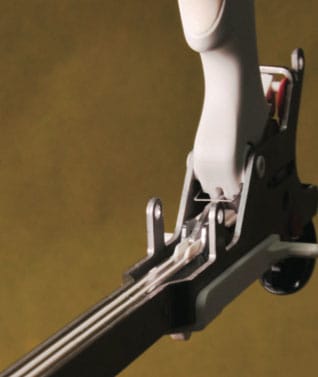
However, there are ways to avoid inconsistency. For best performance, some dry lubricant coating vendors provide pre-mixed and calibrated formulas that maintain consistency in the ratio of carrier fluid to PTFE particles. In addition, some providers offer proprietary “microdispersion” PTFE technology to deposit a thin, smooth film over the treated surface. These microdispersions actually suspend the PTFE in unique carrier fluids to create a better “hang time,” resulting in a more consistent coating and smoother device movements.
Myth #4: Dry Lubricants Aren't Environmentally Friendly
Reputable providers now offer environmentally safe dry lubricants with carrier fluids that possess excellent environmental properties. These new formulas are United States Environmental Protection Agency (USEPA) designated Volatile Organic Compound (VOC) exempt. They are also free of any Hazardous Air Pollutants (HAP) and have an Ozone Depletion Potential (ODP) of zero.
Environmental regulations can be strict and steps must be taken to deliver the most effective coating option that meets these standards by having the least amount of environmental impact. Seek a provider who can deliver expert regulatory compliance support. That expertise will provide ease of mind and help to ensure that the design and manufacture of the device is as efficient and sustainable as possible.
This article was written by Jay Tourigny, Vice President of Operations at MicroCare Medical, New Britain, CT. For more information, Click Here .