
The ability to monitor the activities of ensembles of single neurons is critically important in understanding the principles of information processing in the brain that underlie perception, cognition, and action. Multiple microelectrode recording using appropriate neuronal implants provides this ability. The Telemetric Electrode Array System (TEAS) project aims at developing and embedding a three-dimensional intra-cortical electrode array with all electronics required for signal acquisition, processing, and wireless communication entirely into the head.
Although understanding the human brain with its several billion neurons is a formidable task, recent breakthroughs are leading the way to the realization of “brain-machine interfaces.” By encapsulating an entire brain implant into the skull and using wireless communication through the skull, pathways through the skin that could risk infections and electrical artifacts due to cable movement would be eliminated. This project aims at developing the minimum hardware and software required for an external computer to interface effectively with the brain, by adopting the brain-machine interface concept over the “total implant” concept.
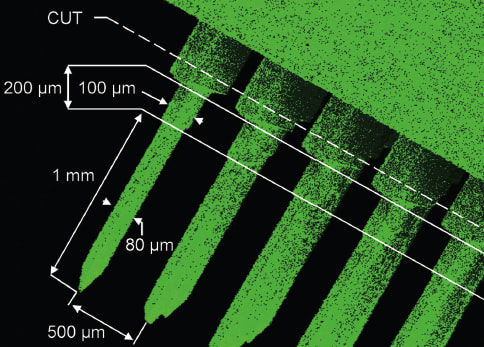
The whole system to be embedded into the skull consists of a three-dimensional electrode array interconnected to an electronic block through a special flexible interconnection cable. The structure of the TEAS array is done using wire electro-discharge-machining (EDM) techniques (see figure). This numerically controlled approach enables machining of more complex microstructures than would be possible with a diamond saw. Tungsten carbide was initially used because of its fine grain and hardness. The entire array or just the tips of the needle electrodes are coated with platinum (for enhancing the charge transfer capabilities) using electron-beam deposition prior to applying an insulation coating of glass using electron-beam deposition or a biocompatible epoxy through a dipping process. In the case of dipping, the surface tension is often too high and heating the array above the annealing temperature of tungsten carbide prior to the dipping process to reduce the surface tension may also be required.
Providing independent electrical access to each electrode in the array is a flip-chip mounting based on stud bumping. With this high-density mounting method, an additional coating of aluminum or gold is applied for the wire bonding techniques over tungsten carbide, platinum, or iridium at the interconnection surface of each electrode to allow ultrasonic wire bonding. The process is the same as that of wire bonding IC die to lead frames.
The flexible attachment provides the electrical connections between the needle electrodes and the electronic block. The initial attachment consists of a single conductive layer of a polyimide-based flexible substrate with 64 conducting traces running in parallel on the top layer between the array and the electronic block. These specifications were chosen to ensure small dimensions while providing a good yield during manufacturing.
Unlike the rest of the system, the electronic block is fixed and attached to the skull. It consists of a front-end amplifier; the analog-to-digital (A/D) conversion and multiplexing; the triggering, control, and buffering subsystem; the wireless communication interface; and the power section.
Although through-hole assembly has been chosen for the first version of the implant to minimize the number of parts and simplify the assembly process, it is anticipated that the flip chip will be used as the feature sizes decrease. As the number of electrodes within the same array increases, the diameter of the needle electrodes will need to decrease to minimize the insertion force and damage to the brain. As such, other fabrication techniques will be required, as well as improvement in wireless communication.
This work was done by S. Martel, I. Hunter, J. Burgert, J. Malasek, C. Wiseman, and R. Dyer of the BioInstrumentation Laboratory at Massachusetts Institute of Technology; and N. Hatsapoulos and J. Donoghue of the Department of Neuroscience at Brown University for the Army Research Laboratory. ARL-0063
This Brief includes a Technical Support Package (TSP).
Wireless Brain Implant Using a Telemetric Electrode Array System
(reference ARL-0063) is currently available for download from the TSP library.
Don't have an account?
Overview
The document discusses the Telemetric Electrode Array System (TEAS) project, which aims to develop a wireless brain implant that integrates a three-dimensional intracortical electrode array entirely within the skull. This innovative approach seeks to eliminate the need for percutaneous connectors and cables, thereby reducing the risk of infections and electrical artifacts caused by cable movement. The TEAS project adopts a system-level design strategy, focusing on the integration of existing off-the-shelf technologies while minimizing the hardware and software required for external computer interfacing.
The primary goal of the TEAS project is to create a compact and efficient brain-machine interface that can monitor neuronal activity, which is crucial for understanding brain functions related to perception, cognition, and action. The document highlights the potential applications of such technology, including the development of prosthetic devices that can restore sensory functions and control limb movements.
The TEAS implant is designed to support a peak neuronal firing rate of 375 Hz across 64 recording channels, with a wireless communication interface based on Bluetooth technology, allowing for data transmission rates of up to 700 kb/s. The system can transmit detailed neuronal spike waveforms or simply time-stamped values, depending on the recording mode selected. An onboard buffer can hold up to 20,000 spikes, enabling efficient data management and transmission.
The electronic block of the implant, which is fixed to the skull, includes components for front-end amplification, analog-to-digital conversion, triggering, control, buffering, and wireless communication. Power for the implant is provided by batteries that are charged through induction via the skin, further enhancing the implant's usability and safety.
The document emphasizes the importance of developing a flexible and adaptable system that can evolve with advancements in electronics and computer technologies. By prioritizing a system-level approach, the TEAS project aims to create a reliable and effective brain implant that can facilitate real-time monitoring and interaction with the brain, paving the way for future innovations in neuroscience and medical technology.
In conclusion, the TEAS project represents a significant step forward in the field of brain-machine interfaces, with the potential to revolutionize how we understand and interact with the brain, ultimately leading to improved treatments and technologies for individuals with neurological impairments.