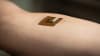

This project aims to improve the estimation of functional properties of breast tissue in near infrared (NIR) imaging. This imaging technique (also known as diffuse optical tomography (DOT)) is noninvasive and non-ionizing, and can be routinely used to characterize the breast tissue. In this technique, fibers placed on the boundary of the breast deliver NIR light (600 nm to 950 nm) and collect the propagated diffused light (the patient fiber-optic setup is shown in the photo). The attenuation and scattering of light through breast tissue volume provide an estimation of functional properties using a model-based approach.

This project is part of a continuing effort to develop methods and algorithms for three-dimensional alternative breast imaging modalities. One important milestone in the project was completing the work on optimizing the NIR data-collection strategies in 3D. A framework to incorporate the spatial-priors into the NIR image reconstruction procedure was developed and also proven to be effective, even in case of imperfect spatial priors. Moreover, a new algorithm that takes into account noise characteristics of the instruments was developed and tested extensively in the simulation studies. Preliminary 3D reconstruction results using this new algorithm show improved quantitative accuracy compared to the traditional image reconstruction techniques.
This work was done by Phaneendra K. Yalavarthy of Dartmouth College for the U.S. Army Medical Research and Materiel Command. ARL-0062
This Brief includes a Technical Support Package (TSP).
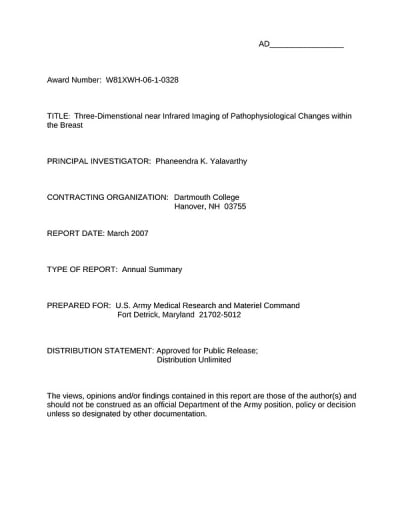
Three-Dimenstional Near-Infrared Imaging of Pathophysiological Changes Within the Breast
(reference ARL-0062) is currently available for download from the TSP library.
Don't have an account?
Overview
The document is an annual summary report detailing a research project titled "Three-Dimensional Near Infrared Imaging of Pathophysiological Changes within the Breast," led by Principal Investigator Phaneendra K. Yalavarthy from Dartmouth College. The report covers the period from February 3, 2006, to February 2, 2007, and is intended for the U.S. Army Medical Research and Materiel Command.
Key research accomplishments highlighted in the report include significant advancements in the optimization of computational aspects of Diffuse Optical Tomography (DOT) image reconstruction. The research focused on improving data-collection strategies and effectively incorporating structural priors into the NIR-DOT image reconstruction process. A generalized least squares minimization formulation was developed, and extensive testing of the algorithm was conducted through simulations.
The report also outlines the reportable outcomes from the first year of the training program, which resulted in two peer-reviewed journal publications and several conference presentations. Notable presentations included a poster at the Optical Society of America Biomedical Optics Topical Meeting in Florida and another at the Network for Translational Research Optical Imaging Network Retreat in California. Additionally, an oral presentation was made at the International Society for Optical Engineering (SPIE) BiOS-2007 conference in San Jose, California.
The document includes a table of contents, which outlines the structure of the report, including sections on the introduction, body, key research accomplishments, reportable outcomes, conclusion, references, publications list, and appendices. The report documentation page indicates that it is approved for public release and provides information on the public reporting burden associated with the collection of information.
Overall, the report emphasizes the innovative approaches taken in the research project, showcasing the potential of near-infrared imaging techniques in understanding and diagnosing pathophysiological changes in breast tissue. The findings and methodologies presented in this report contribute to the broader field of biomedical optics and have implications for improving breast health diagnostics.