
In order to facilitate a more rapid and systematic transfer of new medical knowledge and capabilities into mainstream clinical practice, a new Medical Information Network Decision Support (MINDS) system was developed. This system is intended to be a platform for storing and fusing medical data in a standardized way, and for providing probabilistic diagnostic and treatment decisions to assist doctors and medical researchers in understanding and treating disease.
A key part of this project is the identification of existing standards and protocols that are currently utilized by the medical industry. These standards will be evaluated for their usefulness in the current MINDS project as a first step in making the MINDS system compatible with the existing medical network infrastructure so that it will more easily interface with existing equipment, tools, and information networks. Another key part of the project is an evaluation of prior and existing clinical decision support systems. An analysis will be done to determine which of the existing techniques are useful within the proposed MINDS system architecture. Finally, the project will identify key areas of improvement that will be pursued in future funding cycles in order to develop improved decision support algorithms, data formats and modernized data structures, and general system architecture.
Six core areas have been identified where clinical information systems have provided some level of computerized or automated support to the medical community. Each of these core areas is further regulated by an underlying set of quality control rules, ethical practices, and government regulation. The key contributions that the MINDS system can provide to the broader CIS are in the medical/clinical decision support area, and in the research and training support systems. These data analysis processes can also be mapped to medical processes that can be supported by a data analysis process.
The Computer-based Physician Order Entry (CPOE) and electronic prescribing tools have been developed successfully and are not of primary interest in the MINDS system. However, the automation of data analysis to provide doctors with support of diagnosis and disease propagation, treatment planning for desired outcomes, and preventative care are key interest areas in the MINDS system.
The general decision architecture is modeled after the JDL Fusion model, which has been adapted to fit the appropriate medical terminology. The JDL model helps to associate a data level with the processes involved in analyzing that data. These data analysis processes can also be mapped to medical processes that can be supported by a data analysis process. The modularity of the system is further enhanced by the definition of different software layers. This will improve the overall maintainability of the system.
This work was done by H. K. Armenian of TechFinity, Inc. for the U.S. Army Medical Research and Materiel Command. ARL-0066
This Brief includes a Technical Support Package (TSP).
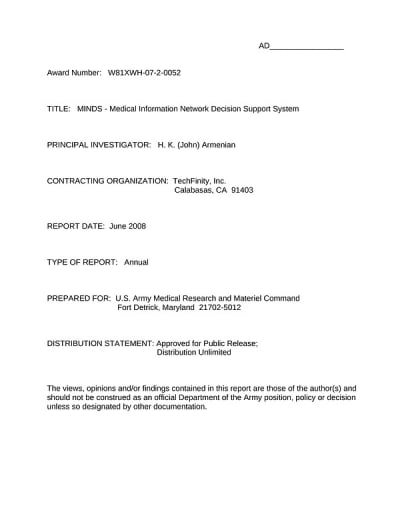
Medical Information Network Decision Support System
(reference ARL-0066) is currently available for download from the TSP library.
Don't have an account?
Overview
The document outlines the progress and objectives of the Medical Information Network Decision Support (MINDS) system, a proposed platform aimed at enhancing clinical decision-making in the medical field, particularly for breast cancer diagnosis and treatment. The MINDS system is designed to store and integrate diverse medical data—from genomic and proteomic information to clinical data—using standardized methods. Its goal is to provide probabilistic diagnostic and treatment recommendations to assist healthcare professionals in understanding and managing diseases more effectively.
The project was initially envisioned as a three-year research initiative with a total funding of $10 million, allocated across three phases from 2006 to 2008. However, due to budget constraints, only $2 million has been secured to date, with approximately $850,000 awarded to TechFinity and another $850,000 pending approval. This funding limitation has necessitated a scaling back of the project's original scope, focusing on a more targeted research program.
Key tasks outlined in the project include enhancing the MINDS system architecture and software framework to improve interoperability with existing health information technologies and clinical decision support tools. The project aims to identify and collaborate with research labs that possess advanced technologies relevant to breast cancer diagnostics and treatment, integrating their capabilities into the MINDS framework.
The document also details the project's tasks, including a comprehensive survey of current health information technology and clinical decision support initiatives, which will inform the development of the MINDS system. This survey will evaluate existing standards and protocols in the medical industry to ensure the MINDS system's contributions are significant and relevant.
The ultimate objective of the MINDS project is to facilitate the rapid and systematic incorporation of the latest medical knowledge and techniques into mainstream clinical practice, thereby improving patient outcomes and empowering healthcare providers. The pilot application will focus on breast cancer, with plans to expand to other diseases in the future.
In summary, the MINDS project represents a significant effort to leverage advanced data integration and decision support technologies to enhance medical practice, particularly in the realm of cancer treatment, despite facing funding and resource challenges.