
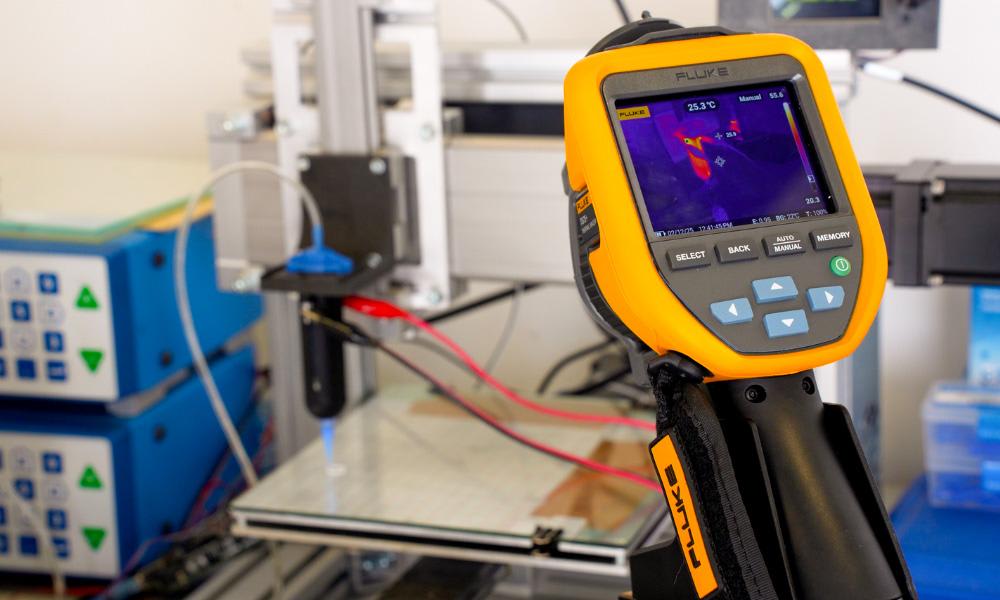
A system has been developed to optimize the electrical, thermal, and mechanical behavior of 3D printed materials. University Carlos III of Madrid (UC3M), in collaboration with the University of Oxford, Imperial College London, and the BC Materials research center in the Basque Country, has developed an innovative computational model that makes it possible to predict and improve the behavior of multifunctional structures manufactured using 3D printers.
This breakthrough, supported by the BBVA Foundation through a Leonardo Grant and published in the journal Nature Communications, opens the door to new applications in sectors such as biomedicine, soft robotics, and other branches of engineering.
“Currently, conductive thermoplastics are very promising because of their ability to transmit electrical signals while providing structural support,” explains one of the study’s authors, Daniel García-González, from the UC3M department of mechanics of continuous media and theory of structures. “But the main challenge in the manufacture of these materials is the control of their internal structure, since the bonding between filaments and the presence of small cavities affect both their mechanical resistance and their capacity to transmit electrical signals,” explains the scientist.
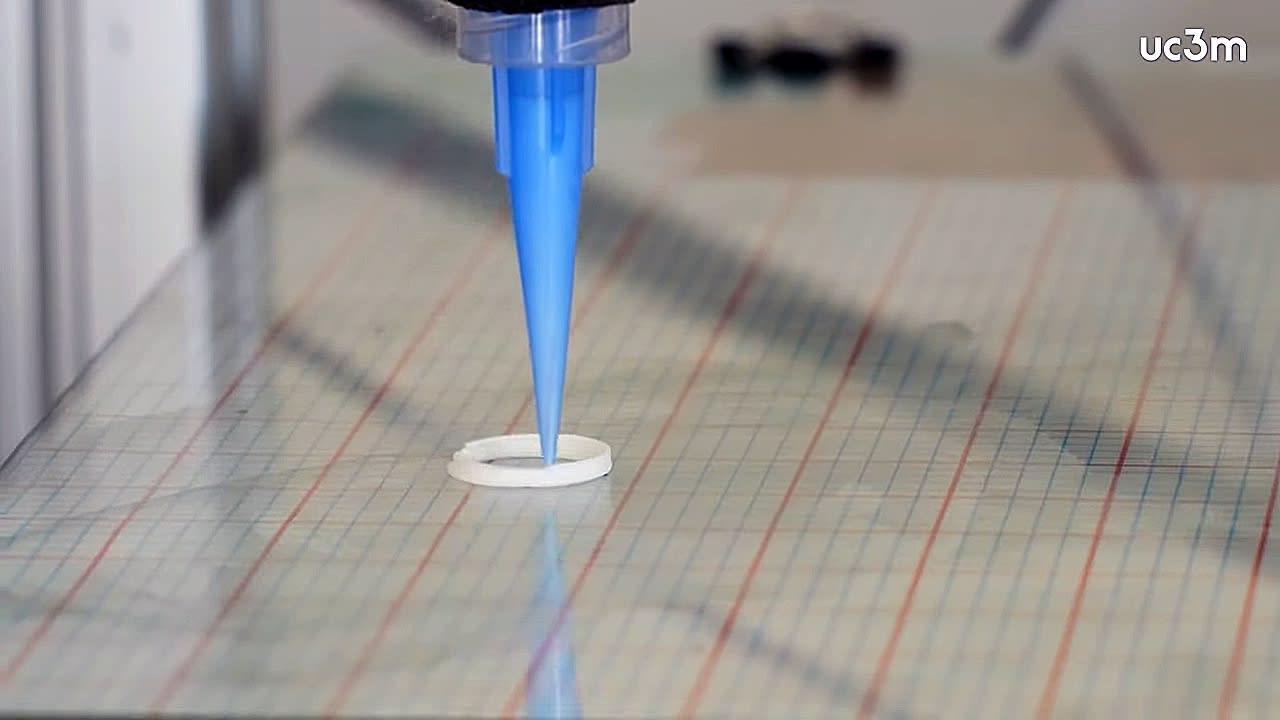
Until now, these factors were considered unavoidable shortcomings of the 3D printing process. However, the researchers have managed to control these characteristics by integrating advanced computational tools and experimental trials, which has allowed them to manufacture structures that are sensitive and capable of transforming mechanical signals into electrical signals.
“A key point about this discovery is that it can be extrapolated to other types of 3D printing technology in which softer materials could be used,” adds Javier Crespo, also from UC3M’s department of mechanics of continuous media and theory of structures. The researchers are optimistic that it will be possible to design materials that lay the foundations for future advances in additive manufacturing, thanks to the combination of these new computational tools.
This new research, backed up by extensive experimental validation, provides a reliable approach to minimizing the differences between the different behaviors of conductive components and represents a major step forward in the design of multifunctional materials, according to its authors. “For example, in the field of engineering, these structures could be used both for the manufacture of soft robots and for obtaining virtual data that can serve machine learning technologies,” notes Crespo.
Emilio Martínez-Pañeda, professor at the University of Oxford and co-author of the study, says that “the research opens up endless opportunities, enabling the development of intelligent materials and sensors that could be of great use in the aerospace industry or in infrastructure monitoring.”
“And not only that,” adds García-González, “with these new materials, we could also create patches or dressings that warn us how many times we are flexing our knee so that, in the event that we have an injury, we are alerted if we are passing certain critical points where we are going to cause damage to our muscles.”
For more information, contact Daniel García-González at
Transcript
00:00:00 A little bit of the context of the work we do. Deals with materials, intelligent structures That to understand it a little, they are structures that not only provide structural support, but they also have some other functional responses integrated. So what we have developed is a platform to develop materials where we combine mechanical, electrical and thermal responses. And we have also tried to understand all these physics and through experimental and computational models, understand how we can use all this
00:00:27 from a manufacturing point of view to design this type of components With platform we refer to a series of processes both experimental and computational, in which we can vary perfectly the input signals that we generate or the fields mechanics etc. both at the experimental and computational level, in order to be able to understand what would happen if we changed these types of signals and in this way be able to optimize and understand what would happen, not only in the specific case we are studying, but if we extrapolate it to a larger field.
00:01:03 Fundamentally, what we have done in this work has been to focus in fused filament type 3D printing techniques, which are the most common currently due to its price and other things, and we have especially used a type of material which is a conductive polymer that allows electricity to flow. This allows us to give it some properties not only structural to all the impressions we make, but multifunctional, in which we can, for example, see how the electrical signals can vary according to mechanical responses.
00:01:33 This can be quite extrapolated to other types of 3D technologies, such as Direct Ink Writing, which allows us to use much softer materials, in which we can use this mechanical and electrical interrelationship to make systems that can interact in human- machine manner and generally they are sensors. They can be temperature sensors, mechanical deformation sensors, where there is a clear interrelationship between how the mechanical response can affect the electrical response, We would have two main fields of application, one is soft robotics. That is, instead of making the typical robot with metals that is hard
00:02:10 and does not have this sensitivity, so to equip this skin to feel, any mechanical effort, an impact or a pressure In the other field it would be more focused on the field of bioengineering or biomedicine, which, for example, can be used in dressings that can tell me If I have a knee injury, letting me know how many times I'm bending it, if I'm overdoing it and I'm passing certain critical points where I'm going to induce damage in my muscles or tendons This work is part of a Beca Leonardo that is funded by the Fundación BBVA and is the first stage of the project. And to do so, Javier, who was the first author of the article,
00:02:49 completed an international research stay at Imperial College. And then we were also in the transition of that team to Oxford University and we have collaborated so much with these investigated in the United Kingdom as with Sergio Lucarini, who is a researcher which is currently in the Pais Vasco, at BC Materials.