

A new nanomaterial from the silk produced by the Tetranychus lintearius mite has the ability to penetrate human cells without damaging them and, therefore, has promising biomedical properties.
The interest of this new material — which is more resistant than steel, ultraflexible, nanosized, biodegradable, biocompatible, and has an excellent ability to penetrate human cells without damaging them — lies in its natural character and its size (a thousand times smaller than human hair), which facilitates cell penetration.
These characteristics are ideal for use in pharmacology and biomedicine since the material is biocompatible with organic tissues (stimulates cell proliferation without producing toxicity) and, in principle, biodegradable due to its protein structure (it does not produce residues).
The resistance of the silk produced by Tetranychus lintearius is twice that of spider silk, a standard material used for this type of research, and stronger than steel.
For more information, visit here .
Transcript
00:00:01 we all know that one ideal material is spider silk however in our research we stumbled over one species of mite in this case tetranijus lintarius which is actually plant feeding mite which is producing copious amount of silk in our previous work we have shown that related spider mite tetra nihos
00:00:32 ertice produces silk of nano dimensions which is actually very specific with very high jung module which represents physical characteristics and this young's module is twice as high as a fiber of spider silk with this idea and one
00:00:58 really international team consisting of our laboratory in canada laboratories in institute of photonics in barcelona laboratory in murcia of jose luis senis in imeda and laboratories here in at university of la rioja our international team was able first to develop methods to culture this mite in
00:01:30 laboratory and then using this copious amount of silk we were able to manufacture nanoparticles and to show that these nanoparticles are supporting growth of cells in culture and also using fluorescent markers we have shown that these nanoparticles are
00:01:52 entering into cell cytoplasm opening possibility that this bio nano material which is natural of proteinaceous feature and biodegradable can be used in biomedicine and idea that we have genome sequence of tetranychos earth is our first mite and now we are in process
00:02:20 of sequencing of the genome of tetranius linterius we have possibility to use dna recombinant methods with idea to produce these nanoparticles in bioreactors and to look for their application in biomedicine obviously one of clear-cut applications is a really targeted delivery of drugs
00:02:47 because our advantage is that these nanoparticles produced by recombinant dna technology can be modified to carry tags which are going to be specific for particular tissues or maybe cells of cancer and that we can attach particular drug on other end of our nanoparticle so with this in mind
00:03:15 our idea is to pursue recombinant production of these nanoparticles in future hoping for different applications in biomedicine in uh development of sensors of different type and also for potential detection of different pathogens what you can see here is 3d
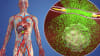
00:03:42 reconstruction of one cell to which we applied our nanoparticles what you can see in red are actin fibers which are delimiting cellular boundaries in blue is nucleus and our nanoparticles are in green so they're entering the cell and they're localized in specific domains
00:04:10 showing that these nanoparticles can be delivered within the cell