

Researchers have developed a wireless ultrasound transducer that is efficiently excited by microwaves. The result is a simple oil-filled patch that can be placed anywhere on the body. No batteries, no wires, and no bath.
The basic principle is based on using microwave absorption to generate sound waves. Microwaves result in lower resolution compared to optical systems, but the scattering is also much lower, so excitation depth is no longer a problem. But, the body’s absorption of microwaves is also very low, so the generated sound waves are very weak.
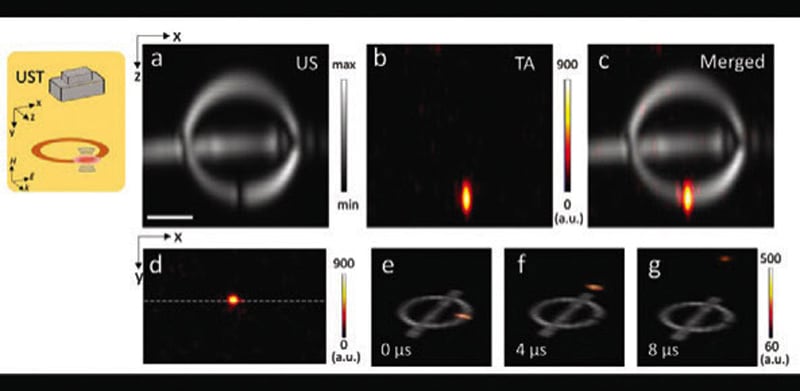
The technique relies on the properties of the split ring resonator. A split ring resonator is a wire loop that is broken. When exposed to microwaves, a current flows in the ring. But, because the ring isn’t complete, the charge “piles up” at the gap, creating a large voltage between the ends of the wire. This large oscillating voltage means that, just in the gap, the absorbed power is high, and thermo-elastically induced acoustic waves are produced efficiently.
For more information, visit here .