
Inside this issue
Overview
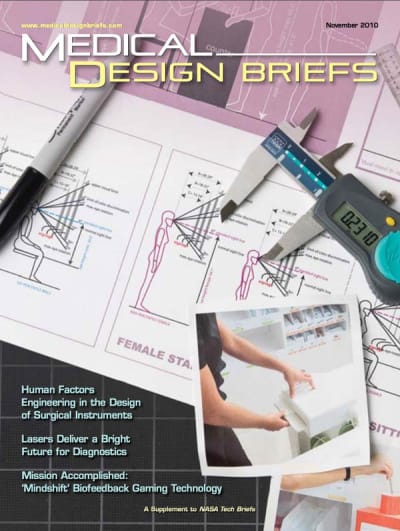
The November 2010 issue of Medical Design Briefs presents a comprehensive exploration of advancements and innovations in medical technology, focusing on various aspects of design, engineering, and application in the healthcare sector. This issue serves as a valuable resource for professionals in the medical design field, offering insights into current trends, technologies, and methodologies that enhance patient care and improve medical device functionality.
Key Articles and Topics
-
Human Factors Engineering in the Design of Surgical Instruments: This article delves into the critical role of human factors engineering in the development of surgical instruments. It emphasizes the importance of designing tools that are intuitive and user-friendly for surgeons, thereby reducing the likelihood of errors during procedures. The article discusses various design principles that can enhance usability, such as ergonomics, cognitive load considerations, and the integration of feedback mechanisms. By focusing on the end-user experience, designers can create instruments that not only improve surgical outcomes but also enhance the overall efficiency of surgical teams.
-
Lasers Deliver a Bright Future for Diagnostics: The potential of laser technology in medical diagnostics is explored in this feature. Lasers are highlighted for their precision and versatility, making them invaluable in various diagnostic applications, including imaging and analysis. The article discusses advancements in laser technology that allow for non-invasive procedures, leading to quicker diagnoses and improved patient comfort. It also covers emerging laser-based techniques that could revolutionize how diseases are detected and monitored, showcasing the ongoing research and development in this field.
-
Mission Accomplished: ‘Mindshift’ Biofeedback Gaming Technology: This article introduces an innovative approach to biofeedback through gaming technology. The 'Mindshift' system is designed to help patients manage stress and anxiety by using interactive gaming elements to provide real-time feedback on their physiological responses. The integration of gaming with biofeedback aims to engage patients more effectively, making the process of learning self-regulation techniques enjoyable and accessible. This approach represents a significant shift in how mental health interventions can be delivered, leveraging technology to enhance patient engagement and outcomes.
Industry Insights
In addition to the featured articles, the issue includes various sections that provide insights into industry trends, product innovations, and expert opinions. Notable highlights include:
-
Laser Micromachining: A focus on precision laser micromachining techniques employed by companies like PhotoMachining, Inc. This technology is crucial for creating intricate components used in medical devices, showcasing the intersection of advanced manufacturing and medical technology.
-
Custom Converting Services: The issue highlights the services offered by Saunders, a 3M Preferred Converter, which specializes in custom converting of flexible materials. This includes die-cutting, laminating, and slitting, which are essential processes in the production of medical devices and components.
-
Advertising and Resources: The magazine provides information on how readers can access free catalogs and literature related to medical design, encouraging professionals to stay informed about the latest products and services available in the market.
Navigation and Accessibility
The magazine is designed with user-friendly navigation features, allowing readers to easily access different sections and articles. The inclusion of a table of contents, zoom functions, and search capabilities enhances the reading experience, making it straightforward for professionals to find relevant information quickly.
Conclusion
The November 2010 issue of Medical Design Briefs serves as a vital resource for medical design professionals, offering a blend of technical insights, innovative technologies, and practical applications. By focusing on human factors engineering, the advancements in laser diagnostics, and the integration of gaming technology in biofeedback, this issue highlights the ongoing evolution of medical design and its impact on patient care. As the industry continues to advance, staying informed through publications like this is essential for professionals aiming to enhance their knowledge and contribute to the future of medical technology.
Features
-
Mission Accomplished
Tech Briefs
-
Preserving Phase for Bionic Implants by Rearranging a Signal’s Components
Thermographic Printing Using Organic Silver Salts
Retractor System for Abdominal Surgery
Repeatable, Low-Cost UV Assembly of Biosensors
Tethered Endoscope for Photographing the Esophagus
Isolation of the 'Paenibacillus phoenicis', a Spore-Forming Bacterium
Cell Radiation Experiment System
Monolithically Integrated, Mechanically Resilient Carbon-Based Probes for Scanning Probe Microscopy