
The cell radiation experiment system (CRES) is a perfused-cell culture apparatus, within which cells from humans or other animals can (1) be maintained in homeostasis while (2) being exposed to ionizing radiation during controlled intervals and (3) being monitored to determine the effects of radiation and the repair of radiation damage. The CRES can be used, for example, to determine effects of drug, radiation, and combined drug and radiation treatments on both normal and tumor cells. The CRES can also be used to analyze the effects of radiosensitive or radioprotectant drugs on cells subjected to radiation. The knowledge gained by use of the CRES is expected to contribute to the development of better cancer treatments and of better protection for astronauts, medical-equipment operators, and nuclear-power-plant workers, and others exposed frequently to ionizing radiation.
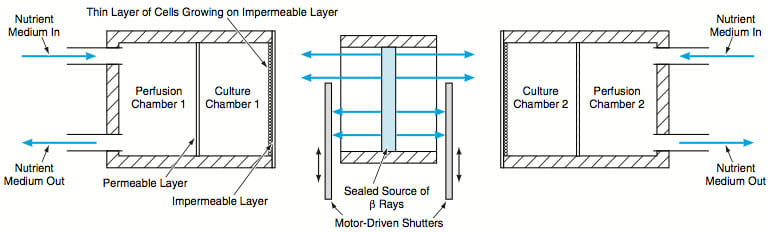
The CRES (see figure) includes one or more cell-culture chambers equipped with a very thin, impermeable Mylar (or equivalent polyethylene terephthalate) membrane at one end, described in more detail below. At the opposite end of each culture chamber there is a perfusion chamber separated from a culture chamber by a permeable membrane. Through this membrane, waste and nutrients are exchanged between the culture and perfusion chambers. A circulation subsystem that includes fluid reservoirs, conduits, valves, pumps, and automated process controls provides for the slow perfusion of the nutrient medium used to culture the cells.
The system includes a source of ionizing radiation in a shielded enclosure with motor-driven shutters that are used to effect timed, selective irradiation of the cell-culture chamber(s). A process-control module exerts overall control over the circulation subsystem and other subsystems to regulate such parameters as the temperature, the rate of circulation of fresh nutrient medium, the pH of the medium, and radiation doses via the shutters. Another subsystem monitors the metabolic rates of cells by measuring ultraviolet fluorescence from the cells, the pH of the medium, and/or the concentrations of O2 and CO2. Still another subsystem under control by the process-control module can be made to introduce a fixative substance to preserve the cell cultures for subsequent analysis. The impermeable front membrane is thin enough to allow the ionizing radiation to pass through. Before installation, the inner face of this membrane is subjected to a special oxygen etch to enable epithelial or other anchor-dependent cells to attach themselves. As a result, a monolayer of cells grows on this membrane and, by virtue of the precision with which their location is thus known, radiation dosimetry can be quite accurate.
This work was done by Dennis R. Morrison of Johnson Space Center. For more information, download the Technical Support Package (free white paper) at www.medicaldesignbriefs.com . MSC-23060-1
This Brief includes a Technical Support Package (TSP).
Cell Radiation Experiment System
(reference MSC-23060-1) is currently available for download from the TSP library.
Don't have an account?
Overview
The document is a Technical Support Package for the Cell Radiation Experiment System (CRES), identified as MSC-23060-1, developed under NASA's Commercial Technology Program. It aims to disseminate the results of aerospace-related developments that have broader technological, scientific, or commercial applications. The CRES is designed to facilitate research on the effects of radiation on biological cells, which is particularly relevant for space exploration where astronauts are exposed to higher levels of cosmic radiation.
The document outlines the purpose and functionality of the CRES, emphasizing its role in maintaining cells in a controlled environment while allowing researchers to study the impact of radiation and various anti-tumor treatments. This research is crucial for understanding how radiation affects cellular behavior, which can inform both space health protocols for astronauts and the development of medical treatments for cancer and other diseases.
Additionally, the document provides contact information for further assistance, specifically from the NASA Johnson Space Center's Technology Transfer Office. This office is responsible for facilitating the transfer of technology and research findings to commercial entities and other organizations interested in applying NASA's innovations.
The document also includes a disclaimer stating that the United States Government and its representatives do not assume liability for the use of the information contained within, nor do they guarantee that such use will be free from privately owned rights. It clarifies that any trade names or manufacturers' names mentioned are for identification purposes only and do not imply official endorsement by NASA.
Overall, the Technical Support Package serves as a resource for researchers and organizations interested in the CRES and its applications, highlighting the importance of understanding radiation's effects on biological systems, particularly in the context of human spaceflight and medical advancements. The insights gained from this research are expected to contribute significantly to both astronaut safety and the development of effective cancer treatments, showcasing the intersection of aerospace research and healthcare innovation.