
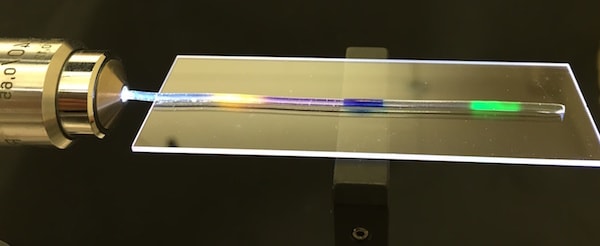
Researchers have developed a biocompatible and highly stretchable optical fiber made from hydrogel. The bendable fiber may one day be implanted in the body to deliver therapeutic pulses of light or light up at the first sign of disease.
The researchers say the fiber may serve as a long-lasting implant that would bend and twist with the body without breaking down. The hydrogel material was highly transparent and possessed a refractive index that was ideal as a core material. They added conjugation chemicals to the cladding solution to generate chemical links between the outer surfaces of both materials.
The researchers loaded a fiber with red, green, and blue organic dyes, shone a laser through the fiber, and stretched a region. They measured the spectrum of light that made it all the way through the fiber, and noted the intensity of the light.
The optical fibers could be implanted or fitted along the length of a patient’s arm or leg, to monitor for signs of improving mobility or they could serve as sensors, lighting up in response to signs of disease.