

Batteries can last longer after hydrogen treatment.
Scientists at Lawrence Livermore National Laboratory (LLNL) say that lithium ion batteries can operate longer as well as faster when their electrodes are treated with hydrogen. Lithium ion batteries (LIBs) are a class of rechargeable battery types in which lithium ions move from the negative electrode to the positive electrode during discharge and back when charging.
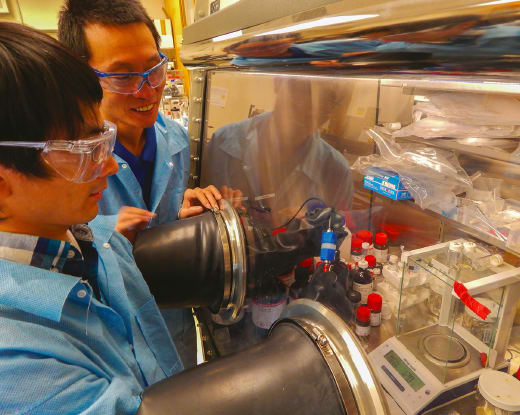
Through experiments and calculations, the Livermore team discovered that hydrogen-treated graphene nanofoam electrodes in the LIBs show higher capacity and faster transport.
“These findings provide qualitative insights in helping the design of graphene-based materials for highpower electrodes,” said Morris Wang, an LLNL materials scientist.
Commercial applications of graphene materials for energy storage devices, including lithium ion batteries, hinge on the ability to produce these materials in large quantities and at low cost. However, the chemical synthesis methods frequently used leave behind significant amounts of atomic hydrogen, whose effect on the electrochemical performance of graphene derivatives is difficult to determine.
Improving Rate Capacity
The LLNL scientists, through their experiments and multiscale calculations, were able to reveal that deliberate low-temperature treatment of defect-rich graphene with hydrogen can actually improve rate capacity. Hydrogen interacts with the defects in the graphene and opens small gaps to facilitate easier lithium penetration, which improves the transport. Additional reversible capacity is provided by enhanced lithium binding near edges, where hydrogen is most likely to bind.
“The performance improvement we’ve seen in the electrodes is a breakthrough that has real-world applications,” said Jianchao Ye, who is a postdoc staff scientist at the Lab’s Materials Science Division.
To study the involvement of hydrogen and hydrogenated defects in the lithium storage ability of graphene, the team applied various heat treatment conditions combined with hydrogen exposure and looked into the electrochemical performance of 3D graphene nanofoam electrodes, which are comprised chiefly of defective graphene.
The team used 3D graphene nanofoams due to their numerous potential applications, in cluding hydrogen storage, catalysis, filtration, insulation, energy sorbents, capacitive desalination, supercapacitors, and LIBs. The binder-free nature of graphene 3D foam makes them ideal for mechanistic studies without the complications caused by additives.
Their research suggests that controlled hydrogen treatment may be used as a strategy for optimizing lithium transport and reversible storage in other graphene-based anode materials.
For more information, visit www.llnl.gov/news .