
https://news.ncsu.edu
Humans grow to be quite efficient at walking. Simulations of human locomotion show that walking on level ground at a steady speed should theoretically require no power input at all.
However, people expend more energy during walking than any other activity in daily life, and for the elderly and those with mobility issues or recovering from injury, researchers from Carnegie Mellon University and North Carolina State University say that energy can be precious.
How It Works
Using an unpowered exoskeleton to modify the structure of their ankles puts an extra “spring in each human step”, they say, which may benefit both the able-bodied, such as the military infantry, as well as victims of stroke or other gait impairments.
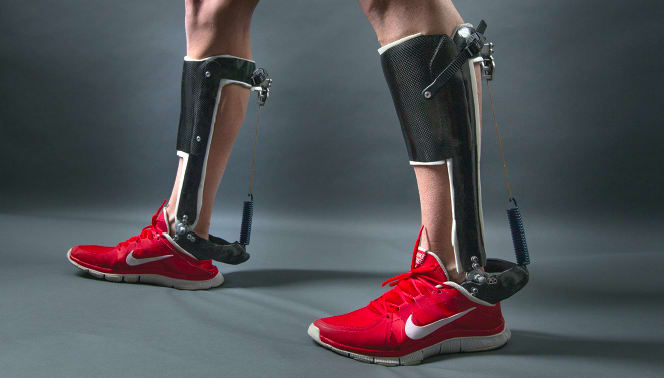
The researchers tested a lightweight lower-leg device that uses a spring and clutch system working in tandem with calf muscles and the Achilles’ tendon while people walk. The streamlined, carbonfiber non-motorized device weighs about as much as a normal loafer, around 500 grams, and requires no energy from batteries or other external fuel sources.
The assistive device is the result of eight years of incremental work, mapped out on a whiteboard by Steven Collins, PhD, an assistant professor of mechanical engineering at Carnegie Mellon, and Greg Sawicki, PhD, in the Joint Department of Biomedical Engineering at NC State University, when they were graduate students together at the University of Michigan in 2007.
The researchers performed careful analyses of the biomechanics of human walking in order to design a simple, ultra-lightweight device that relieves the calf muscle of its efforts when it isn’t doing any productive work. Ultrasound imaging studies had revealed that the calf muscle exerts energy not only when propelling the body forward, but also when it performs a clutch-like action, holding the Achilles tendon taut.
“Studies show that the calf muscles are primarily producing force isometrically, without doing any work, during the stance phase of walking, but still using substantial metabolic energy,” Collins explained. “This is the opposite of regenerative braking. It’s as if every time you push on the brake pedal in your car, you burn a little bit of gas.”
Their resulting ankle exoskeleton offloads some of the clutching muscle forces of the calf, reducing the overall metabolic rate. A mechanical clutch engages when the foot is on the ground and disengages when the foot is in the air, to avoid interfering with toe clearance. This clutch takes over the effort of the calf, producing force without consuming any energy, thereby reducing the overall metabolic rate.
In developing the device, the research team realized that when adding weight to the legs, there is an initial penalty that increases energy costs. For that reason, it was critical to keep the device lightweight. With that in mind, the team developed a carbon-fiber design that is ultra-light, rugged, and inexpensive to produce.
In the future, the team intends to test the current device with individuals who have a variety of mobility issues to determine what designs might work best for different populations. They are also interested in developing exoskeleton components for the knee and the hip, where they believe they may be able to garner even larger benefits.