
Melanoma is the deadliest form of skin cancer, causing more than 75 percent of skin-cancer deaths. If caught early enough, it is usually curable. Researchers at Duke University, Durham, NC, say that they have created a camera that can take high-resolution images of the entire human body, to help doctors spot cancer early and save lives.
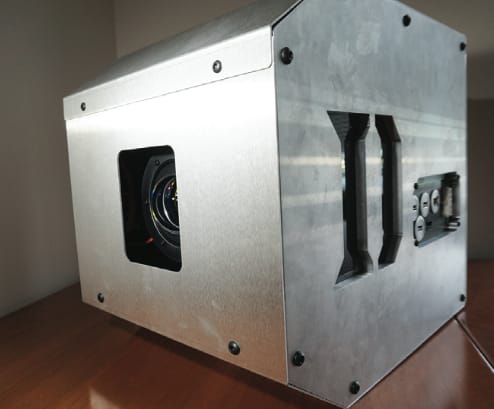
“The camera is designed to find lesions potentially indicating skin cancers on patients at an earlier stage than current skin examination techniques,” said Daniel Marks, one of the co-authors on the paper. “Normally a dermatologist examines either a small region of the skin at high resolution or a large region at low resolution, but a gigapixel image doesn’t require a compromise between the two.”
Although whole-body photography has already been used to identify melanomas and exclude non-dangerous “stable” lesions, the approach is typically limited by the resolution of the cameras used. A commercial camera with a wide-angle lens can easily capture an image of a person’s entire body, but it lacks the resolution needed for a dermatologist to zoom in on one tiny spot. So dermatologists typically examine suspicious lesions with digital dermatoscopy, a tech nique to evaluate the colors and microstructures of suspicious skins not visible to the naked eyes. The need for two types of images drives up costs and limits possibilities for telemedicine.
How It Works
The gigapixel camera developed by the Duke team is a multiscale design consisting of a single moncentric objective and and 34 microcameras. With a structure similar to a telescope and its eyepieces, the camera combines a precise but simple objective lens that produces an imperfect image with known irregularities. The 34 microcameras are arranged in a dome to correct the aberrations and form a continuous image of the scene. The exposure time and focus for each microcamera can be adjusted independently, and a computer can do a preliminary examination of the images to determine if any areas require future attention by the specialists.
While the resolution of the gigapixel camera is not as high as the best dermatoscope, it is significantly better than normal photography, they say, allows for a larger imaging area than a dermatoscope, and could be used for telemedicine, which could make the routine screening available to a larger number of people, even in re mote locations.
Though the camera will still have to prove effective in clinical trials before becoming routinely available to patients, the researchers have gathered enough preliminary data on a healthy volunteer to demonstrate that it has adequate resolution and the field of view needed for skin disease screening. The next step, they say, is to test how well it works in the clinic.