
The routine action of taking a person’s temperature belies the critical importance of obtaining accurate body temperature to assess the health of a patient. Subtle variations in body temperature can indicate potentially harmful conditions, and as such, a number of technologies have been developed to detect skin temperature changes that can serve as early indicators of disease development and progression.
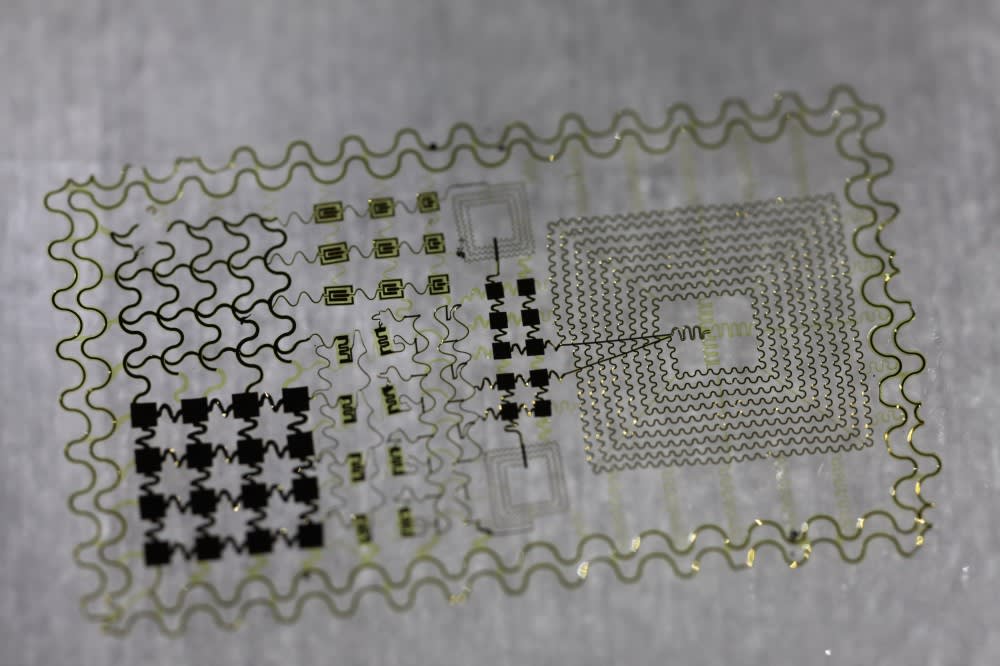
Sophisticated infrared digital cameras can detect, in high resolution, temperature changes across large areas of the body, while small paste-on temperature sensors provide simple, single-point measurements. Now, an international multidisciplinary team including researchers at the University of Illinois at Urbana/Champaign and the National Institute of Biomedical Imaging and Bioengineering (NIBIB), Bethesda, MD, has developed an entirely new approach: a sophisticated ”electronic skin” that adheres non-invasively to human skin, conforms well to contours, and provides a detailed temperature map of any surface of the body.
The temperature sensor array is a variation of a novel technology called “epidermal electronics,” consisting of ultrathin, flexible skin-like arrays, which resemble a tattoo of a micro-circuit board. The arrays developed with NIBIB contain sensors and heating elements. The technology offers the potential for a wide range of diagnostic and therapeutic capabilities with little patient discomfort. For example, sensors can be incorporated that detect different metabolites of interest. Similarly, heaters can be used to deliver heat therapy to specific body regions; actuators can be added that deliver an electrical stimulus, or even a specific drug. Future versions will have a wireless power coil and an antenna for remote data transfer.
In this research study, the array contained heat sensors so that it could be tested for its ability to accurately detect variations in localized skin temperature when compared to the infrared camera. A number of separate physical and mental stimulus tests were performed to compare the two, and the profiles of temperature changes were virtually identical between the two methods.
The investigators also performed a test used as a cardiovascular screening procedure. Blood flow changes are detected by changes in skin temperature as blood moves through the forearm while a blood pressure cuff on the upper arm is inflated and deflated. Once again, the infrared camera and the array technology showed virtually identical temperature change profiles.
Beyond serving as a test to validate the accuracy of the skin array, this experiment demonstrated that the device could potentially be used as a rapid screening tool to determine whether an individual should be further tested for disorders, such as diabetes or cardiovascular disease, that cause abnormal peripheral blood flow. It could also be a signal to doctors and patients about effects of certain medications.