
Dizziness and balance issues are the most frequently reported symptoms following exposure to an improvised explosive device.

“A measure was needed not only for the original assessment of soldiers following an IED event, but also to follow the progress of the soldier during rehabilitation and to determine when the soldier is ready to return-to-duty. Screening and assessment of the balance deficits associated with traumatic brain injury (TBI) is easily accomplished by experienced otolaryngologists/ENT physicians. Unfortunately, it is rare to have such specialized doctors available at the first level of treatment,” said Dr. Angus Rupert and Dr. Benton Lawson researchers at the U.S. Army Aeromedical Research Laboratory (USAARL), a subcommand of the U.S. Army Medical Research and Materiel Command.
To that end, USAARL researchers, Rupert and Lawson developed the Vibrotactile Balance Rehabilitation Device.
How it Works
The initial technology, called the Tactile Situation Awareness System, was developed about 20 years ago.
“TSAS was designed for astronauts to maintain spatial awareness while in the zero gravity environment of space and to recover balance function following return to earth. It helps rotary wing aviators maintain spatial orientation while flying in degraded visual environments, such as brownout. The Vibrotactile Balance Rehabilitation Device evolved from TSAS,” said Rupert.
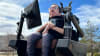
The Vibrotactile Balance Rehabilitation Device is a single horizontal belt of tactors worn around the waist for situations where information concerning rising and falling in the vertical direction (e.g., altitude) are not as important. The goal of this device is to allow for screening, assessment of recovery, and rehabilitation of balance deficits following TBI, allowing injured soldiers to return-to-duty.
The device detects body sway via changes in pressure on a platform on which the patient stands. When sway goes beyond therapist-determined limits, a vibration cue is delivered in the direction of the excessive sway. The patient corrects his/her balance by moving away from the excessive sway signal.
“The process appears to be even more intuitive and immediate than the steering corrections a person makes when his/her car accidentally drifts into the rumble strip on the side of the road,” said Lawson.
Where it Stands
The U.K.’s Defence Medical Rehabilitation Centre received the tool on loan February of 2011 at Fort Detrick. The commanding officer of the U.K.’s Defence Medical Rehabilitation Centre experienced the Vibrotactile Balance Rehabilitation Device during a demonstration in the U.S. Realizing its potential to enhance rehabilitation of people with balance deficits, he sought to obtain one of the devices. The objective of the CRADA/MTA is to loan DMRC a Vibrotactile Balance Rehabilitation Device, which will be used as part of a series of ongoing assessments to evaluate devices, procedures, and regimens that may assist injured service personnel to relearn balance as part of their rehabilitation process. Feedback on its efficacy and suggestions for improvements will be considered as modifications in both hardware and software are made to the device.
The device has been sent to various centers for evaluation, including Naval Medical Center San Diego and hospitals in the Orlando and Philadelphia area. The targeted end users include the Naval Medical Center, Walter Reed Army Medical Center, National Intrepid Center of Excellence, Defence Medical Center Headley Court, and other civilian evaluation/rehabilitation sites.
More Information
This article was written by Tiffany Holloway for MRMC Public Affairs. For more information about the Vibrotactile Balance Rehabilitation Device, visit https://mrmc.detrick.army.mil .