
White Paper: Design
Why Integrated Product Development is the Future of Medtech
SPONSORED BY: ![]()

We’re excited to share that Sunrise Labs is now Suntra MedTech Solutions. This change reflects our expanded services in consulting, engineering, and innovation—and our commitment to meeting the evolving needs of our clients.
Visit our website to learn more about why we’ve rebranded and how this positions us for the future.
You can also download our white paper for a deeper look at our vision.
Don't have an account?
Overview
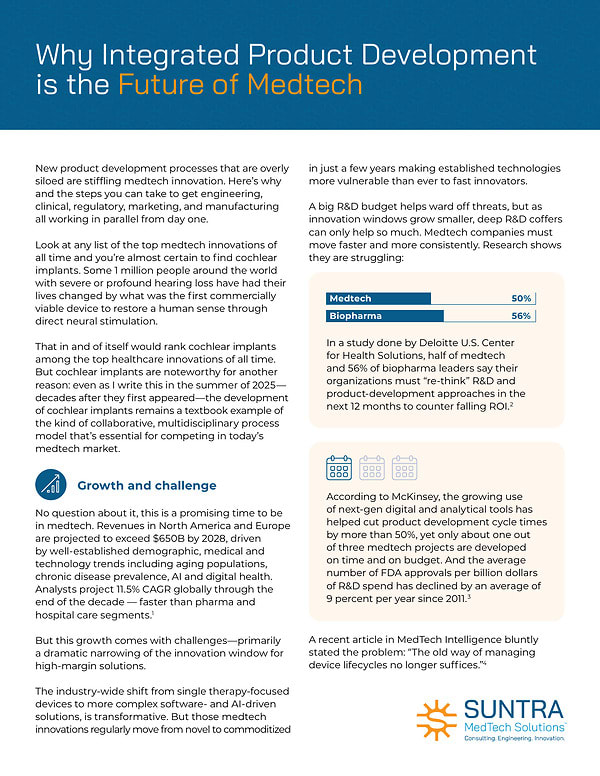
The document discusses the challenges and opportunities in the medtech industry, particularly focusing on the importance of integrated product development processes. It highlights how siloed approaches in new product development stifle innovation and lead to inefficiencies, increased costs, and safety concerns. The cochlear implant is presented as a landmark innovation, showcasing how a clearly defined goal and collaborative efforts among engineering, clinical, regulatory, marketing, and manufacturing teams can lead to successful outcomes.
The document outlines the negative impacts of siloed development, such as market misalignments, technical shortfalls, and costly recalls, exemplified by Abbott’s FreeStyle Libre glucose monitoring systems. These issues arise when teams prioritize their functional areas over a unified product development vision, leading to disconnects that can compromise product safety and efficacy.
To combat these challenges, the document proposes five key steps for implementing an integrated approach to new product development:
-
Establish a Common Project Mission: Define the project's purpose and strategic importance to align all team members.
-
Anchor Decisions in User Requirements: Conduct early human factors studies to ensure that user needs and clinical requirements guide the development process.
-
Create Core Multidisciplinary Teams: Form permanent cross-functional teams that remain committed to the project from concept through launch, integrating regulatory and clinical considerations from the start.
-
Keep Data Visible and Relevant: Eliminate data silos by ensuring all team members have access to critical information, promoting collective ownership of data.
-
Operate in Unison, Not in Sequence: Replace traditional gated checkpoints with regular integrated design reviews, allowing for real-time feedback and adjustments across all functions.
The document emphasizes that adopting an integrated approach not only enhances efficiency but also improves safety and accelerates the time-to-market for innovative medical technologies. It calls for a shift away from traditional siloed practices to a more collaborative model that can better navigate the complexities of the medtech landscape. By leveraging multidisciplinary teams and fostering a culture of collaboration, organizations can drive meaningful innovation and maintain a competitive edge in the rapidly evolving industry.