
An obstacle to successful cancer drug therapy is the existence of drug delivery barriers, which result in insufficient and heterogeneous drug delivery to the tumor tissue. This drug delivery problem not only limits the clinical application of existing chemotherapeutics, but also decreases the effectiveness of many new drugs under development. Photodynamic therapy (PDT), a modality involving the combination of a photo-sensitizer and laser light, is an established cancer therapy. This work demonstrates the effectiveness of vascular-targeting PDT in eradicating tumor tissue, and modifying vascular barrier function for enhanced drug delivery.
It was found that microtubules play an important role in photosensitization-induced endothelial morphological and functional changes. The mechanism involved in PDT-induced endothelial cell morphological and functional changes was investigated. Results indicate that multiple factors can contribute to endothelial cell function disruption. Verteporfin-PDT induced the formation of reactive oxygen species and the release of calcium. Calcium release has been shown to cause the microtubule depolymerization and induce endothelial cell morphological changes.
Intravital fluorescence microscopy was used to continuously monitor tumor bloodflow velocity, vessel diameter, and vascular permeability in prostate tumors after vascular-targeting PDT using three different doses of photosensitizer verteporfin (0.25, 0.5, and 1.0 mg/kg). The effects of PDT on blood perfusion and vascular permeability followed a reverse dose dependence. A higher dose of verteporfin PDT was more effective in inducing perfusion disruption, but less effective in enhancing vascular permeability and macromolecule accumulation. These results indicate that a lower dose of verteporfin PDT is more favorable for enhancing tumor drug delivery.
Intravital fluorescence microscopy also was used to compare the tumor accumulation of fluorochrome-labeled dextran molecules with molecular weight of 155 and 2000 kDa after three different doses of photosensitizer verteporfin (0.25, 0.5 and 1.0 mg/kg). PDT using verteporfin was more effective in enhancing the tumor accumulation of a lower-molecular-weight dextran molecule than a higher-molecular-weight dextran molecule.
Since most chemotherapeutic agents tend to be associated with albumin in circulation, a whole-body fluorescence imaging system was used to monitor TRITC-albumin tumor uptake in real time on live animals. It was found that vascular leakage of fluorescence-labeled albumin (TRITC-albumin) was significantly increased after the vascular-targeting PDT, as compared to the control tumor. PDT-induced increase in TRITC-albumin accumulation was especially pronounced in the tumor periphery.
Light and electron microscopy were used to examine vessel structural changes after PDT. At the light microscopy level, PDT induced vessel dilation and occlusion at early time points after treatment, which progress to severe vessel degeneration and rupture at late times. At the electron microscopy level, platelet aggregation, thrombus formation, and endothelial cell rupture occurred.
Photodynamic tumor vascular targeting induced significant vascular morphological and functional changes. As a result, tumor accumulation of fluorescence molecular probes with different molecular weight is significantly enhanced after photodynamic vascular targeting.
This work was done by Bin Chen, Ph.D., of the University of the Sciences, Philadelphia, for the Army Medical Research and Materiel Command. For more information, download the Technical Support Package (free white paper) at www.medicaldesignbriefs.com . ARL-0102
This Brief includes a Technical Support Package (TSP).
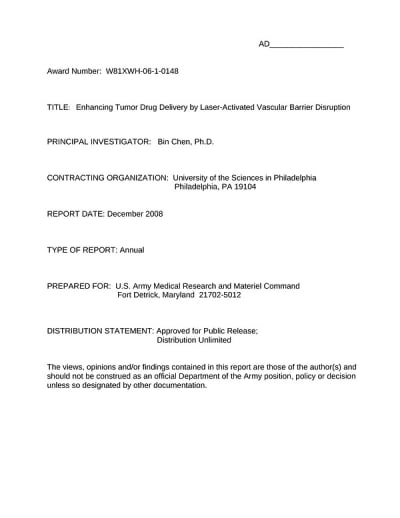
Enhancing Tumor Drug Delivery by Laser-Activated Vascular Barrier Disruption
(reference ARL-0102) is currently available for download from the TSP library.
Don't have an account?
Overview
The document titled "Enhancing Tumor Drug Delivery by Laser-Activated Vascular Barrier Disruption" is an annual report prepared by Dr. Bin Chen and Dr. Chong He from the University of the Sciences in Philadelphia, covering the research conducted under Award Number W81XWH-06-1-0148 for the period from November 30, 2007, to November 29, 2008. The report addresses significant challenges in cancer treatment, particularly the barriers to effective drug delivery to tumor tissues, which often necessitate higher drug doses and can lead to toxicity in normal tissues.
The primary focus of the research is on photodynamic therapy (PDT), a treatment modality that combines a photosensitizer with laser light to disrupt tumor vasculature. This disruption is crucial as it enhances the delivery of therapeutic agents to tumors by overcoming the vascular barriers that typically limit drug accumulation in cancerous tissues. The report highlights the effectiveness of PDT in increasing the permeability of tumor blood vessels, thereby facilitating the transport of macromolecules and drugs to the tumor site.
Key findings from the research include the observation that PDT leads to significant changes in the endothelial cell structure, such as microtubule depolymerization and the formation of intercellular gaps, which contribute to increased vascular permeability. These effects were demonstrated using intravital fluorescence microscopy and whole-body fluorescence imaging techniques, confirming that PDT can enhance the accumulation of circulating therapeutic agents in tumors.
The report also discusses the potential of combining PDT with existing chemotherapeutics to improve treatment outcomes for localized prostate cancer, which represents a significant portion of prostate cancer cases. The ongoing clinical trials for PDT indicate promising results, suggesting that this approach could be a safe and effective method for treating localized prostate cancer.
In conclusion, the report emphasizes the importance of PDT as a novel strategy to enhance drug delivery in cancer therapy, addressing a critical barrier to effective treatment. The findings support the continued exploration of PDT in clinical settings, with the hope of improving therapeutic efficacy and patient outcomes in cancer care. The document is approved for public release and aims to inform the U.S. Army Medical Research and Materiel Command of the advancements made in this area of research.