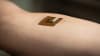

Researchers from Northwestern University, the University of Illinois at Urbana-Champaign, and the University of Pennsylvania are the first to demonstrate a flexible silicon electronics device used for a medical application. The device produced high-density maps of a beating heart's electrical activity, providing a potential way to localize and treat abnormal heart rhythms.
The technology holds promise for a new generation of flexible, implantable medical devices, for the treatment of abnormal heart rhythms or epilepsy, as well as new flexible sensors, transmitters, and photovoltaic and microfluidic devices.
The mechanical design allows the device to conform to and wrap around the body's irregularly shaped tissues. It uses 288 contact points and more than 2,000 transistors positioned closely together. By bringing electronic circuits right to the tissue, rather than having them located remotely, the device can process signals right at the tissue. This close contact allows the device to have a much higher number of electrodes for sensing or stimulation than is currently possible in medical devices.
Click here for the full story .