
A new type of sensory feedback system for a myoelectrically controlled biomimetic prosthetic hand was developed. One of the characteristic features of the human neuromuscular control system is the increase in the compliance around a joint with decreasing activity of a muscle. Interferential current that uses two waves and interferences was used to synthesize a low frequency in the body. One frequency was fixed at 4,000 Hz and the other frequency was changed from 3,700 Hz to 4,000 Hz. As a result, stimulus frequency in the body was changed from 0 Hz to 300 Hz. It was measured that the subjects could distinguish the change of stimulus frequency, and confirmed that the interference current is a useful method for sensibility feedback of a prosthetic hand.
In developing a prosthetic hand, three points are important. The first is that its shape should be similar to a human hand. The second is that an amputee must be able to voluntarily control the opening and closing of the hand. The third is the ability to transmit the status of the hand to the amputee.
If a prosthetic hand has the same mechanisms and mechanical properties as the neuromuscular control system of the human hand, an amputee may be able to utilize almost the same subconscious control as used before amputation. Consequently, training periods required for the amputee to operate such a prosthetic hand would be much shorter than that for a conventional myoelectric hand. If the prosthetic hand has the ability to transmit the status of the hand, such as finger angle or grasping force, to the amputee, the amputee will be able to execute fine tasks or handle breakable objects more easily with this hand than with conventional myoelectric prosthetic hands.
Four stainless steel electrodes were fixed on the forearm with electrode paste. In the experiment, the channel-1 frequency was fixed for 4,000 Hz and the channnel-2 frequency was changed as follows: 1) How an interference wave was felt when both frequencies were at 4,000 Hz was measured; 2) The frequency at which the subject felt a change each time the channel-2 frequency gradually decreased from 3,999 Hz to 3,700 Hz was measured; and 3) The frequency at which the subject felt a change each time when the channel-2 frequency gradually increased from 3,700 Hz to 3,999 Hz was measured. Each experiment repeated ten times for each of eight healthy young volunteers.
The result shows that the subjects could feel the frequency change precisely in cases of frequency decrease. This means that more information will be needed when the prosthetic hand grasps an object as compared with releasing an object. Therefore, the change of channnel-2 frequency should decrease when the prosthetic hand grasps the object and increase when the prosthetic hand releases the object.
This work was done by M. Yoshida of the Department of Biomedical Engineering and and Y. Sasaki of the Graduate School of Engineering at Osaka Electro-Communication University, Japan, for the Army Research Laboratory. ARL-0068
This Brief includes a Technical Support Package (TSP).
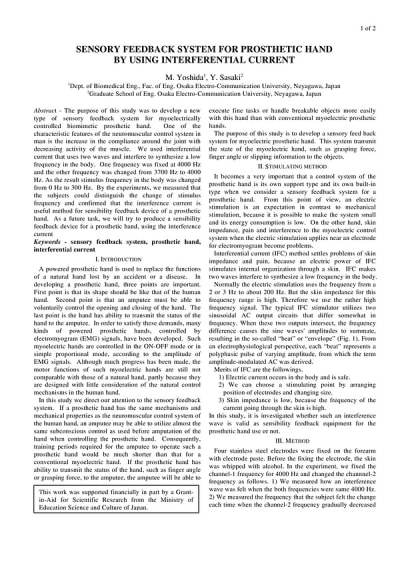
Sensory Feedback System for Prosthetic Hand Using Interferential Current
(reference ARL-0068) is currently available for download from the TSP library.
Don't have an account?
Overview
The document presents a study aimed at developing a sensory feedback system for myoelectrically controlled prosthetic hands using interferential current (IFC). The primary goal is to enhance the functionality and user experience of prosthetic hands by mimicking the natural control mechanisms of the human hand. The study emphasizes the importance of providing amputees with feedback about the status of their prosthetic hand, such as finger angle and grasping force, to facilitate fine motor tasks and improve overall usability.
The research highlights the limitations of conventional myoelectric prosthetic hands, which often lack the ability to transmit sensory information back to the user. By integrating a sensory feedback system, the study aims to shorten the training period required for amputees to adapt to using a prosthetic hand, thereby improving their quality of life.
The methodology involved using two stainless steel electrodes placed on the forearm of healthy volunteers. One electrode was fixed at a frequency of 4000 Hz, while the other was varied between 3700 Hz and 3999 Hz. The study measured the subjects' ability to perceive changes in stimulation frequency, which is crucial for effective feedback in a prosthetic hand. Results indicated that subjects could distinguish frequency changes, confirming the potential of IFC as a viable method for sensory feedback.
The findings revealed that subjects were more sensitive to frequency decreases than increases, suggesting that the feedback system should be designed to decrease frequency when the prosthetic hand grasps an object and increase it when releasing. This approach aligns with the natural behavior of the human hand, where more sensory information is needed during grasping than releasing.
In conclusion, the study confirms that interferential current is a promising method for developing a sensory feedback device for prosthetic hands. Future work will focus on creating a practical device that incorporates these findings, ultimately aiming to enhance the functionality and user experience of prosthetic hands for amputees. The research underscores the potential of advanced sensory feedback systems to bridge the gap between artificial and natural hand function, offering hope for improved prosthetic technology.