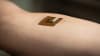

Merging custom chemistry and 3D printing, University of Washington scientists created a bone-shaped plastic tab that turns purple under stretching. The low-cost, mechanical sensor offers an easy way to record the force on an object.
Gregory Peterson and Michael Larsen, UW doctoral students in chemistry, created a polymer and fed the soft plastic into the UW chemistry lab’s commercial 3D printer.
One print head contained polycaprolactone, similar to what a 3D-printer company sells as Flexible Filament. The other print head contained a plastic with occasional insertions of a molecule, spiropyran, that changes color when it is stretched.
The printed tab is a piece of white plastic with barely visible stripes that turn purple under force. The acts as an inexpensive, mechanical sensor with no electronic parts.
The sensor may be used to record force or strain on a building or other structure. The 3D printing technology also offers new possibilities, said the researchers, for individualized medical implants or other custom shapes that incorporate engineered molecules that respond to their environment.