
The medical device industry has come a long way in the last 20 years. Part of the evolution has come from advancements in other industries, such as information technology, plastics and polymers, and chemicals and adhesives. Today’s devices are much smaller, yet more complex, than we have ever seen before. We have also seen a significant evolution in terms of customer demand, expectations, and spending power. Countries such as Brazil, India, and China, that were nowhere on the radar of Western medical device companies two decades ago, are now some of the fastest growing markets with enormous untapped potential. Financial liberalization, a rising middle class, increases in wages, and a rapidly aging population have fueled increased demand for medical devices, and that demand is only expected to grow. This has led to fierce competition in the medical device industry, with companies facing significant pressures to out-innovate one another.
Unfortunately, the rush to market with new products has led to a steady rise in reported medical device failures and recalls, which has significantly increased the need for regulatory oversight. For this reason, ensuring medical device quality has become one of the most critical functions within the industry. According to a 2011 FDA report, Understanding Barriers to Medical Device Quality, an analysis of root cause data revealed that failures in product design and manufacturing process control caused more than half of all product recalls. A McKinsey Center for Government report, The Business Case for Medical Device Quality, went further, putting a dollar value on the cost of product recalls and estimating that the total costs, plus revenue loss due to non-routine quality events, are between $2.5B and $5B.
Whether it is low volume medical devices, such as pacemakers and infusion pumps, or high volume products, such as hypodermic needles and catheters, manufacturing process control takes center stage. Often, the steps in the process that are easiest to control and fix are the most frequently overlooked. Evaluating and making changes in these steps can help avoid an enormous amount of rework and rejects, reduce failures in the field, and save time as well as money. One such step is fluid dispensing.
Fluids are dispensed for numerous applications and cover the gamut of products used in and for the medical industry. They are used for bonding, gasketing, filling, lubricating, and sealing, among numerous other uses. All types of fluids are used, from the thinnest to the thickest, two-part combinations, those that change viscosity, to those that need light curing. Dispensing can be done in single pieces, batches, or for volume manufacturing with fully automated in-line systems. Especially for medical devices, where accuracy and reliability have always been extremely critical, controlling the fluid dispensing process has become more important than ever before. With recently increased regulations and stringent standards, fluid dispensing equipment manufacturers and fluid formulators have had to adapt their products to accommodate the new medical product and market complexities.
Dispensing Challenges and Trends in Manufacturing Medical Products

The biggest dispensing challenge is achieving batch-to-batch consistency. Given how tight the regulations and tolerances are, and how small and complex the assemblies are, it becomes increasingly difficult to develop a process that is consistent, accurate, and reliable.
Companies are looking for more flexibility as a number of products are often produced on the same manufacturing line. Process parameters, fluids, and valves often have to be changed on the fly.
Regulations are much tighter than they were five years ago. Given the recent spate of product recall notices, the FDA and other agencies will play an even more significant role in the upcoming years.
Companies are beginning to pay increased attention to trends including sustainability, that is to say greener manufacturing, lower energy consumption, decreased use of hazardous solvents, and lower waste generation.
Finally, the miniaturization trend has led to ever smaller fluid volumes. With the wearables industry already witnessing explosive growth, miniaturization will be one of the most important trends going forward.
Evolution in Fluid Dispensing Methods
Precision fluid dispensing is the application of a fluid to a substrate in a precise, controlled, repeatable, and consistent manner, day after day, month after month, and year after year. This directly ties to the quality of the final product. The specific application will determine what type of dispensing equipment and what processes should be used. Numerous factors go into that decision. When selecting a dispense valve, for example, considerations include the dispensing material, viscosity, reactivity, dispense distance, and dispense angle, just to name a few. (See Figure 1)
When it comes to dispensing equipment, whether it is a simple system involving syringes and manual benchtop dispensing, or a more complicated procedure that uses automated valves or robots, it is very likely that there are significant process improvement opportunities that exist within a manufacturing facility. Even if a process was examined in the past, recent innovations, such as jetting of fluids and modular valves, have changed the industry.
As medical device complexity and throughput have increased and manufacturing real-estate, so to speak, has decreased, the fluid dispensing equipment industry has evolved to keep up with these changes. The valves on the market today can dispense fluids in amounts as little as 0.2 nanoliters in volume and 50 microns in size and can handle viscosities from a water-like 1 to 5 cPs to thick pastes with viscosities up to 1,000,000 cPs. Valve geometries are also shrinking such that many valves are smaller than the palm of your hand. This means that more valves per unit area can be installed in one in-line machine. There is a changing trend towards more process controls, closed-loop systems that monitor the operation and provide feedback on the fly, and software that makes programming a dispensing system easy, fast, and accurate, with step-by-step video training manuals.
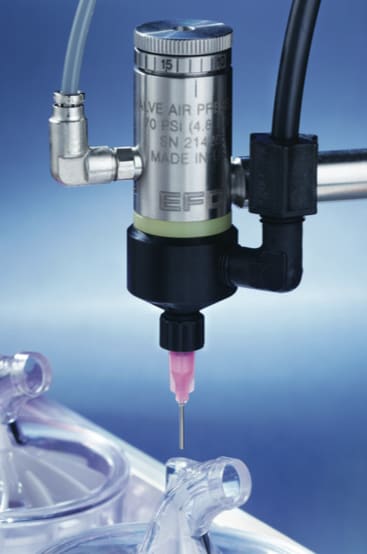
Another trend is the widespread acceptance of non-contact dispensing methods, based on piezoelectric actuation systems or jetting technology. With traditional contact dispensing, depending on the complexity of the medical device, contamination or damage may occur to fragile substrates through contact with the needle. In the case of medical electronics, with so many components tightly spaced on a small board or device, it is difficult to place a needle in many areas or get close enough to components. In addition, the Z-axis movement to raise and lower a needle takes up valuable time. With jetting, Z-axis movements are eliminated because the fluid is ejected from the valve as it passes over the substrate, thus making the dispense process much faster. Non-contact jetting protects the product and/or the substrate and increases precision because the fluid can be dispensed into difficult to reach areas and can compensate for varying heights or irregular surfaces like flexible circuits. (See Figure 2)
Reducing or eliminating downtime and maintenance costs has gained renewed emphasis. While the typical contact dispensing valve runs up to 60 million cycles before scheduled maintenance, a jetting valve can run up to 500 million cycles before maintenance is necessary. Even piezoelectric valves have evolved. The new generation of valves have a modular design and offer the flexibility to swap out only the parts that might be worn out while keeping the valve body in place. Replacing just the worn out part instead of the entire valve saves both money and time. When only the faulty part of a valve needs replacing, it only takes minutes to change, rather than hours or days.
Curing Technologies also Play a Part
Closely related to dispensing, especially with adhesive dispensing, are curing technologies. As companies pay more attention to sustainability and greener manufacturing, LED curing is gaining popularity when compared to traditional arc lamp curing. LED curing technology offers many advantages over traditional techniques including smaller, more compact machines, longer lifetime, lower maintenance, lower operating temperatures, and lower power consumption. The process is also completely mercury and ozone free.
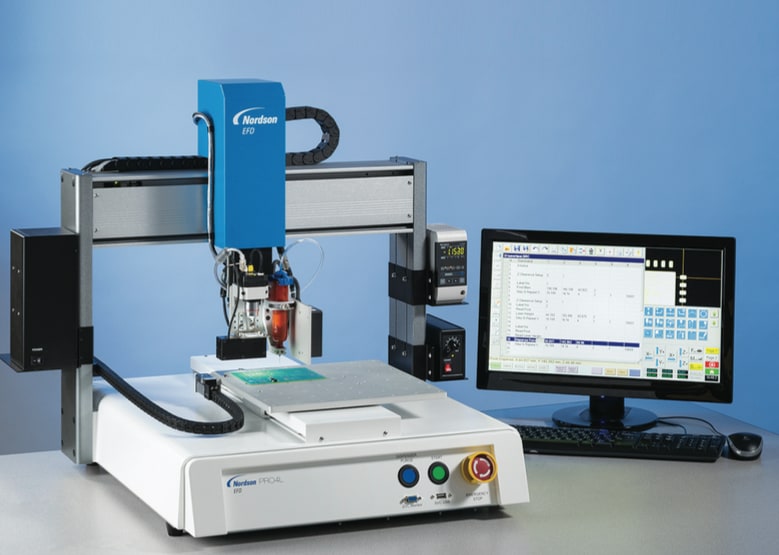
Semi-automated and automated robots are another developing technology trend. As robots become “smarter” and incorporate features that were previously reserved for high-end equipment, they offer significant opportunity for companies to automate some of their processes, but have been reluctant in the past due either to the lack of equipment with the features they needed or cost constraints. Vision capability has become quite common in robots today. Vision systems provide first pass quality control on the fly and help to significantly reduce rejects. Calibration takes a lot less time and is much less dependent on user skill now. The software is much more intuitive, easier to use, and more functionality rich than it was before. (See Figure 3)
Fluid dispensing has evolved to such an extent that it can perform the exact operation, with the specific tools needed, to fit each company’s process and product requirements. It can increase productivity, lower cost-of-ownership, improve quality and reliability, and reduce time-to-market. But to take advantage of these improvements, each application must be carefully evaluated to select the most appropriate dispensing solution. Dispensing needs should be viewed from a systems perspective rather than trying to cobble together various components to make them work.
As the technology of medical devices has advanced, the fluid dispensing equipment manufacturers have had to develop products and technologies to implement those needs in a cost effective manner. A greater degree of collaboration is occurring in the design and production of medical products by the medical companies, the fluid formulators, and the dispensing equipment manufacturers. Such collaborations result in a cost effective way to get new products to market quickly without sacrificing quality.
Whether it is investing in the latest dispense valve technology or implementing tabletop automation, a customized dispensing solution could exist that previously did not. By reevaluating the current assembly processes with knowledge of these new technologies, manufacturers can achieve significant cost savings, reduced downtime, and a higher quality in their products.
This article was written by Amit Arora, Global Market Development Manager, Nordson EFD, East Providence, RI. For more information, Click Here .