
Bioengineers from the Jacobs School of Engineering at University of California, San Diego have developed a self-healing hydrogel that binds in seconds - as easily as Velcro - and forms a bond strong enough to withstand repeated stretching. The material has many potential applications, including medical sutures, targeted drug delivery, industrial sealants, and self-healing plastics.
Transcript
00:00:10 it functions like velcro at the molecular level now our gels have these pendant arms that can actually reach across the interface and then bond to each other my name is Amaya Fudd gate I'm a fourth year PhD student in bioengineering at the UC San Diego Jacobs School of Engineering I work on bio-inspired materials in shiny Vargas's laboratory
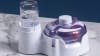
00:00:34 so what we have here are our self-healing gel I've dyed one of them yellow and the other purple and so this is so that we can see the Cata interface a lot clearer on camera and so what I'm going to do now is I'm going to transfer each of these gels into a low pH solution and now I'm going to bring the two pieces together we don't really need to
00:01:05 press them we just have to bring it so that the surfaces are touching we want to leave them for a couple seconds and now when I lift this out we see that it's healed within a few seconds and so what this does is funk it functions like velcro at the molecular level now our gels have these pendant arms that can actually reach across the interface and then bond to each other
00:01:34 and this reaching across is actually reversible depending on what the pH is and so we see this as useful in a couple of different applications the first one is in a purely industrial aspect where you can use this as a sealant for acid leaks the other interesting thing since we aren't the Department of bioengineering we're interested in how this interacts
00:01:56 with human or animal tissues this is very interesting for use as a tissue adhesive since this operates at a low pH that is the environment of the stomach we see this as especially interesting in controlled drug delivery to ulcers or even potentially sealing a perforation in the stomach you you