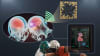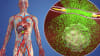

"Blindsight is a condition that some patients experience after having damage to the primary visual cortex in the back of their brains. What happens in these patients is they go cortically blind, yet they can still discriminate visual information, albeit without any awareness." explains Tony Ro, a neuroscientist at The City College of New York. Ro is artificially recreating the condition in his lab. Ro. With support from the National Science Foundation, Ro is developing a clearer picture of how other parts of the brain - besides the visual cortex - respond to visual stimuli. He says understanding and mapping these alternative pathways could be the key to new rehabilitative therapies.
Transcript
00:00:10 MILES O'BRIEN: This brave soul is about to willingly and knowingly go blind. No, he hasn't lost his mind. He's taking part in an experiment that recreates blind sight. TONY RO: Blind sight is a condition that some patients experience after having damage to the primary visual cortex in the back of their brains. What happens in these patients is they go cortically blind. They can't see any information in their visual world. MILES O'BRIEN: While no one is ever going to say blind sight is 20/20, neuroscientist, Tony Ro, says it holds tantalizing clues to the architecture of the brain. TONY RO: There are a lot of other areas of the brain that are involved with processing visual information, but without any visual awareness. So these other parts of the brain receive input from the eyes, but they're not allowing us to access it consciously.
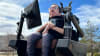
00:00:59 MILES O'BRIEN: With support from the National Science Foundation, Ro is developing a clearer picture of how other parts of the brain, besides the visual cortex, respond to visual stimuli. RESEARCHER: ...click on the left. And if you see a diamond, click on the right. (Clicking sound) MILES O'BRIEN: That clicking is a powerful magnetic pulse being shot right into this man's visual cortex, disabling it and blinding him, just for a fraction of a second. TONY RO: That blindness occurs on the order of about one-twentieth of a second or so. MILES O'BRIEN: Just as the pulse blinds him, a shape flashes onto a computer screen in front of him. Turns out, 60 to nearly 100 percent of the time, test subjects report back the shape correctly. TONY RO: They'll be at significantly above chance levels at discriminating those shapes, even though they're unaware of them. Sometimes they're nearly perfect at it.
00:01:49 MILES O'BRIEN: In case you are concerned, the blindness wears off almost immediately. No lasting effects. But the findings are telling. TONY RO: What this condition of blind sight tells us is that there are likely to be a lot of alternative visual pathways that go into the brain from our eyes, that process information at unconscious levels. MILES O'BRIEN: Ro says understanding and mapping those alternative pathways might be key to new rehabilitative therapies. TONY RO: Currently we have a lot of soldiers returning home who have brain damage to visual areas of the brain. We might be able to rehabilitate these patients. MILES O'BRIEN: And that's something worth looking into. For Science Nation, I'm Miles O'Brien.