

Missouri S&T research team has developed a new light-based 3D printing method that could speed up and simplify the process of making organs-on-a-chip — small tissue-like devices that are used for medical research and drug testing.
“The human body has about 37 trillion cells, and nearly every one must be close to a capillary to survive,” says Dr. Anthony Convertine, an associate professor of materials science and engineering. “Re-creating those dense micro-capillary networks is a major engineering challenge for tissue engineering, but our work offers a path toward overcoming that barrier.”
Convertine says an organ-on-a-chip is usually about the size of a baseball card and lets scientists observe how hu-man tissues respond to new medicines or treatments with-out testing on animals or people.
He describes the traditional method for 3D printing tissue as building everything point by point in a way that is comparable to an inkjet printer slowly plotting individual dots on a page. This process could be more efficient, Convertine says.
“Point-by-point fabrication works, but it becomes slow and ex-pensive when you try to create the intricate networks of tiny channels that living tissues rely on,” he says. “Our approach uses a light-curable, self-assembling resin that forms sacrificial struc-tures. After printing, we dissolve those structures to leave clean, precise microchannels. It is faster, simpler and easier to scale.”
The method also uses a one-pot approach, combining both the resin that will later be dissolved and the material used to form the chip’s microchannel system into one mixture, which can reduce processing steps and accelerate how quickly labs prototype and test designs.
The S&T research was featured the journal Biomaterials Science.
For more information, contact Dr. Anthony Convertine at

Overview
This document reports on advancements in polymerization-induced self-assembly (PISA) printing, a novel additive manufacturing approach that combines reversible addition–fragmentation chain transfer (RAFT) polymerization with digital light projection (DLP) photolithography. Unlike conventional DLP resins that form permanent covalent crosslinked networks, this method employs multi-chain transfer agent (multi-CTA) functional scaffolds that form physically crosslinked polymer networks. These networks balance mechanical robustness with reversible assembly, enabling the fabrication of high-resolution three-dimensional structures that can be selectively dissolved or modified post-printing.
A key innovation is the introduction of a simplified, one-pot, purification-free synthesis for multi-CTA scaffolds (MCFS). This method uses a RAFT copolymerization of N,N-dimethylacrylamide (DMA) with a small amount of bisacrylamide (MBAC) in aqueous or ethanolic media, producing branched polymers bearing multiple RAFT agent functionalities. By varying monomer compositions—diacetone acrylamide (DAAm), acrylamide/2-hydroxyethyl acrylamide (AM/HEAM), and isobornyl acrylate (IBA)—the authors tailor resin solubility and dissolution behavior, facilitating multi-material printing with precisely controlled sacrificial layers.
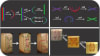
Atomic force microscopy (AFM) analysis demonstrates the formation of well-defined nanoscale morphologies through PISA, including uniform spherical domains in DAAm resins and vesicle-like structures in IBA resins. Mechanical stability arises from hypothesized physical crosslinking via interparticle bridging and entanglement (“knots”) between phase-separated domains. These physically crosslinked gels maintain structural integrity during printing yet dissolve cleanly in specific solvents.
The authors showcase applications such as fabricating intricate, perfusable microcapillary networks relevant to tissue engineering and regenerative medicine. A three-layer printing strategy integrates structural and sacrificial layers, allowing selective dissolution of sacrificial layers to form open microchannels. Additionally, printed sacrificial scaffolds enable the creation of PDMS-based microfluidic devices with hollow channels, demonstrating potential for microfluidic and biomedical device fabrication.
Resolution optimization studies indicate that incorporating photoabsorbers like phenol red reduces overcuring and enhances printing precision, enabling faithful reproduction of fine vascular architectures.
In summary, this work advances PISA printing by providing an accessible synthetic route to robust, physically crosslinked resins with tunable dissolution, enabling rapid fabrication of complex, multi-material, perfusable structures. This platform offers significant promise for high-throughput, high-resolution microfabrication and tissue engineering applications, bridging gaps between mechanical robustness, printing speed, and post-printing adaptability.